Ask Amma

Archive for the ‘How’ Category

Enforcing Bedtime

In How on 23 August 2012 at 3:34 am

Last night was a bad one.  When it was time to go to bed, my 7-year old flat out told me no and that I couldn’t make her do anything, that she would do whatever she wanted.  She is testing her boundaries big time.  Combine that with screaming, crying, throwing things, kicking doors… horrible, horrible night.  All because yesterday I let her stay up late.  Or maybe raging pre-tween hormones!   Normally I discuss and compromise.   A friend told me to stick to my guns.  How would you instruct a child who is demonstrating zero respect for elders and breaking items in the house?

– Mom of a 7-year old in Maryland

Regarding respect for elders, I am in favour of it (as well as respect for children) and regarding breaking items (or will) I am against it. When tensions escalate it can become very difficult to handle these situations, so it helps to have a plan. “Stick to your guns” is not a constructive plan.  Your daughter’s screams and throws are not her guns.  Your job is not to outgun her with threats and punishments, but to look behind the outburst.  What is the child trying to say?  Has she in fact tried to say it in quieter, constructive ways but just not been listened to and then resorted to louder means?  Secondly, as Alfie Kohn reminds us to ask, is what we have requested reasonable?  Can we explain our reasons?  Can we listen to our children’s reasons for their requests – if we start from the premise that they are reasonable, then we are more likely to hear them.

After the screaming has begun it may be well past the time for reasons.  But if you are reading this, I take it there is no screaming going on at present, so you can use this time to think about these questions.

Regarding the specific case of staying up late, I can claim some experience in this area.  Rather than telling an alert and eager child that the lights must go out, I find it more effective to plan the day so that it is full and satisfying.  If waking up on time is becoming a problem, then I would talk about that with my child and see what suggestions she might have, while also being prepared to offer some of my own, if needed.

You say that you also normally discuss and compromise, but she is crossing the limit.  Limits can serve as a topic of conversation, exercising our ability to hear each other’s point of view.  Children (and adults) may need limits, but these limits can be set by mutual consent.  Not in the heat of the outburst, but some other, cooler, closer time.

Losing Patience

In How on 3 July 2012 at 8:10 pm

I feel I am often losing my patience these days. I end up raising my voice, or at least having that tone of anger, admonishing, or worse, I fall into the popular trap of bribing her with something to take her away from something else.

Right after I have talked to my daughter in a harsh tone, I often give her a hug, say sorry, and explain, but that is still not where I want to be.

– Mom of a 3 year old in Texas

To get where we want to be as parents, there are a number of good sources of help. You will get there. I will get there. Along the way there will be times we wish we could go back and do differently, or more likely DO NOTHING (in capital letters). Those moments hold the potential to be our best teachers. Read the rest of this entry »

How do I make my daughter write?

In How on 9 May 2012 at 3:37 am

My baby is [age].  A week ago she started to learn to write … but she doesn’t want to write and refuses to hold the pencil.  Otherwise she loves to scribble on the wall but doesn’t want to write letters and she starts to cry.  Please help me –  how do I make her write?

– from Mothering.

Can you tape a large paper to the wall, at the height accessible to her?  Then she can scribble freely.    I have visited homes of parents who paint one wall black and keep chalk available for children and visitors – of all ages.

My guess is that she does not want to write letters designed by others because she is busy exploring the pencil and its possibilities.  Imagine that you have arrived at a beautiful mountain and are being asked to sit and study a particular rock.  Your limbs yearn to wander about the mountain.  Even if you stay and study the rock, your mind is wandering.  On the other hand, after running about to your heart’s content, if you then study the rock, you may actually be more curious and whatever you learn will stay with you as you continue exploring.

As babbling is a valuable stage of experimentation with language, so is scribbling a valuable exercise – making lines and curves and shapes appear, as if no one had ever done it before.  It will lead to writing, but it is also valuable in itself, and should not be rushed or cut short.

Baby on the train – whom to sensitize?

In How on 11 April 2012 at 4:37 pm

While it is ok for D’s experiments to carry on at home with full freedom, what about outside where other people are not as tolerant? Do I need to restrict her when she is being a little bit too friendly for other people’s liking? Whom do I sensitize – my baby or the other passengers?

– mother of a 2 year old in Bangalore

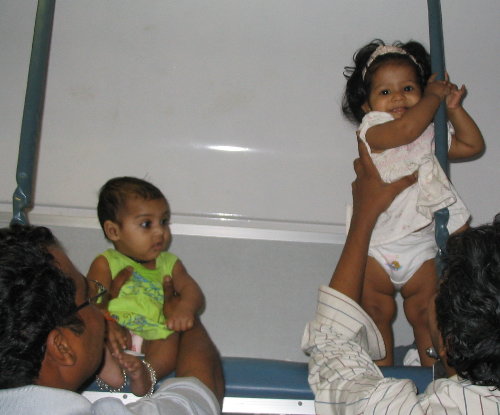
The message I sense that you are getting from these passengers is, “Control your child, this is not a playground.” Your daughter is thinking, this is way better than a playground – it moves, and there are so many more people to play with! If you agree with her, find more people on the train who share her view and let them play to their hearts’ content. On an overnight journey, try to ensure that she gets enough play during the day so that she is ready for bed at night when passengers are sleeping.

Babies enjoy the Indian Railways … especially the upper berth!

Babies enjoy the Indian Railways … especially the upper berth!

Read the rest of this entry »

Make your own ring sling

In How, Uncategorized on 27 December 2011 at 8:00 pm

So you are handy with a needle and have a wonderful piece of cloth that you would love to convert into a ring sling.

It is fairly easy to sew your own ring sling.  The key is to get good sturdy rings.  Just get 2 1/4  metres of fabric.  If you are tall or if you like having a bit of cloth to use as an an extra layer when it is chilly, then get 2 1/2 metres.

Pleat the cloth and slide 2 rings through it.  When you reach 9 inches or so, fold it over and sew it down.  This holds the rings in place and also creates a light padding for your shoulder.  This is still considered an unpadded sling – padded slings have a thicker, softer shoulder pad.

Here are some diagrams from the ring sling sewing instructions page on the Maya Wrap site: Read the rest of this entry »

Baby suddenly stopped nursing

In How on 27 October 2011 at 3:50 am

My 4 month old suddenly refuses to nurse. I put him to the breast and he screams … what should I do? I am worried about losing my already low supply.
– new mother in Goregaon.

A pause or “strike” in nursing is not uncommon. Kelly Mom, an essential reference for nursing moms, has a detailed page: Help! My Baby Won’t Nurse! To calm your worries about supply, can you pump while trying out ways to get past this phase?

Could it be that he is not comfortable in cradle position? Could you try nursing while carrying him upright on your hip? I used to do this with baby in the sling so that she could nurse as I walked around or did other things – this way she had interesting things to look at and did not have to sacrifice that for the sake of nursing. Is he gaining new mobility? If he is too busy to nurse while awake, you could try more nap-nursing and night-nursing.

Skin-to-skin contact also helps. If you can arrange some of the times while you are both asleep, or while he is in the sling, to keep your shirt open so that he can latch on by himself without waking all the way up it might facilitate more nursing.

As with many phases, of nursing or of parenting in general, by the time one finds a work-around, the phase itself passes.

How do you know? So what?

In How on 27 October 2011 at 3:46 am

ऐसा तोड़ी न हो सकता है … It’s impossible to climb Mt Everest?
आप को किस ने बताया? – How do you know?
तो क्या? …. So what??
कुछ भी बोल रहे हो! ….you’re bluffing

Everything credible is being questioned? Everything authentic is being invalidated? This is a new defiance that I hear in my child….he’s been now 2 months in this mode…what’s breeding here?

– mom of 7 year-old in Maharashtra

Ah, age 7. I remember it well. Reminded me of age 3.5, when the pain of realizing that some things in this world just make no sense seems to have turned upside down the rational world of my earnest little child. We have no answer for that angst. But just because we have stopped asking Why? for so many things, how can we say they should too?

Let me guess what might be prompting your 7-year-old’s questions:
– he wants to test the limits of "facts." Who decided these anyway?
– he wants to know how we know things, and this may be more important to him than the "facts" themselves.
– others seem / claim to know things he does not and he wants to level the playing field, challenge them on what they know

– he gets asked similar questions by friends
– he is going through an "information spurt" where he is getting exposed to a stream of "facts" from people, news, books, media and wants to set up some accuracy and relevance filters, kind of like his own toll both on this superhighway.

As I said, above are only guesses. But I congratulate him on his investigative spirit. If he rejects, for example, the idea that the earth is round, let him keep his search open until he is satisfied. Next time you are on the seashore let him observe the ships coming over the horizon. You need not bring up the shape of the earth, he can if he wants. Probably the specific question was not as important as establishing his right to search for answers himself, rather than accepting facts as stated.

And most (all?) facts hold only within certain conditions – how many times have I said something like "that will break if it falls," only to hear my daughter reply, "not if it falls from 1 centimeter" and promptly demonstrate the same. While the talkback can get annoying, would you actually want the thinking behind it to stop?

Weaning … and Free Learning

In How on 27 October 2011 at 3:00 am

My weaning story, originally titled “Weaning: Fountain of Free Learning,” was edited and published in Breastfeeding Today, October 2011 here on page 14. I think they did a decent job condensing.  Here is what I wrote in 2009:

Weaning: Fountain of Free Learning

Weaning: Fountain of Free Learning

     We often hear that nursing a baby provides not only food but also love, comfort and immunity.  As a mother, I found it was all this and more.  I discovered breastfeeding to be a quintessential experience of free learning, right up to and including child-led graduating.   Natural, free, unscheduled, ungraded, untested and self-guided, the experience of breastfeeding gives the child far more than nutrition or even the oft-remarked “brain-boosting DHA.”  Reflecting back on nursing my daughter, I find that it gave her precious time, space and context to learn numerous life skills – not only eating, but also ways to understand her body, her mind and the world around her.  No one could give her a certificate that she had learned.  She moved on when she was ready.

*   *   *   *  *

It is over year since my daughter’s last breastfeeding.  She weaned over a period of 2-3 months, as the gaps between nursings became longer and more frequent … and then I realized it was no longer a gap.  It was all.  One June day when I first noticed a gap of more than a week, I couldn’t resist asking my daughter about it, though I was not sure if I was “supposed” to bring it up at all.  She simply said, “I don’t need it anymore.”  (She did nurse a few more times in July and August.)  My husband gasped, “what?  but you are supposed to have ampa (short for amma-palu, which in Telugu means mama-milk).”  They both giggled.

At the time I hardly talked to anyone about it. I have always been vocal about breastfeeding, calmly answering people who were shocked to see me breastfeed and NIP (nurse-in-public) well past the World Health Organization’s recommended minimum of 2 years.  Though I was bursting with it, what time or place to bring up the story?  Most of my family and friends might not have known she was “still” nursing, or even thought about it.   Without planning to, I did pour out to one friend, a fleet-footed newlywed engineering consultant in Washington, DC, whose views on breastfeeding or motherhood I knew not in the slightest.   She listened.   We laughed through moist eyes.   Later one day, entirely by luck, I found myself in the library on the day of our monthly La Leche League meeting.  I shared my experience.  Recently I again attended LLL after more than a year’s gap and a couple of moms remembered my story.  They had understood (of course).

They encouraged me to “write it down.”  And so here it is.

I always knew that I would breastfeed.  My mother was in La Leche League when my little sister was born and I went to my first LLL meeting  (as an adult) while I was pregnant. Though we had difficulties in the beginning, we got established after a few days and nursing was smooth after that.   There were ups and downs, of course.  At nine months my daughter loved idlis (steamed rice-and-bean cakes) so much I worried that she was not nursing enough.  At 15 months there was a time when she did not nurse for more than 24 hours and I worried because I knew that was too early to wean.  At 22 months she was nursing like a baby, waking up every 2 hours at night and all.  (Soon after the nursing spurt she had a growth spurt.)  Through all these ups and downs, I never lost confidence in nursing; moreover I had terrific support from mothering.com/discussions and La Leche League online community forums, even though I knew few nursing moms in real life.

When my daughter was three I observed that she was nursing 3-6 times / day.  To sleep, to wake up, once in the middle, and often a couple of times during the day.  I remember noting that it did not seem to be tapering off in any way.  Could this actually end?

When she was 3 ½, I was most grateful that she was nursing.  That winter she got sick three times in three different places  – Delhi, Bombay, and Rasuru (Orissa), each time with high fever, and once with measles.  Each time she nursed right through her illnesses.  Though she was sick and needed to direct all her energy towards healing, she was not uncomfortable.  Through breastfeeding, mostly in her sleep, she was getting plenty of fluids, rest and nutrients.   She certainly couldn’t keep any food down (we tried that too).

Nursing helped our daughter to develop healthy eating habits.  She ate on her own, right from her introduction to ragi (millet) at 6 months, and soft fruits like banana and sapota, soft vegetables like peas, sweet potatoes, plantain, beets, and onwards to grains, beans, and beyond.  She ate whole grains from the beginning – whole millet, brown rice, whole wheat bread, mung and urad dal were also unpeeled.   We simply served her food and she ate as much as she wanted, with her own hand.  We usually ate together.  If she needed more time she would eat by herself as I took care of other work.  Or read a book.  Eating was always a happy and relaxed experience; never a chore, either for her or for us.  Through mother’s milk she became familiar with the diverse tastes of all that I ate; I think that served as a preview to whet her appetite for the real thing. Since she was breastfeeding I knew she was getting her nutrition so it did not matter how much solid food she ate.  With this freedom she embraced, at her own pace, the array of whole, natural foods we prepared.

Weaning from the breast signified not only a transition from one source of food to another, but also a transition in the way my daughter understood herself and dealt with the world. The basic ability to gauge one’s own hunger and satiety, cultivated at the breast, will serve one well at the plate.  Over the years I came to recognize that breastfeeding offers so much more than nutrition.  It offers immunity not only to germs but also to excessive stimuli from the environment.  It nurtures one’s sense of wholeness, it is comfort after a fall or stress, and of course, it is a warm cozy place to let down one’s guard and sleep.  The world offers alternatives for all of these functions, and the child who learns to avail these at her own pace will utilize them wisely.

Because breastfeeding often required me to take my daughter to work, it allowed her to be in interesting environments observing adults busy in various activities.   Also, it gave adults a chance to share time and space with a child and accept a nursing toddler as normal.  One small step towards building our continuum society.

Around age four, I again noticed that she was nursing nearly every night and sometimes during the day as well.  I wondered how long she would nurse, but did little more than wonder.  Once when she skipped a day I spent hours writing in my journal.  What does this mean?  But the next day she was back; meaning was forgotten.

It started soon after her fifth birthday.  Till then she was going strong with no signs of tapering off.  Two weeks later however, I observed that she’d skipped several days.  Was I ready for this?  I couldn’t say she was too young.  She was even past the oft-quoted “worldwide average” of 4.2 years.  So what was I missing?

Wasn’t I now supposed to be celebrating – increased wardrobe choice, one less mile to go before I sleep?  Sure, there would be plenty of days ahead to enjoy that.  Now I was immersed in a rush of feelings, and savoring that rush.   It passes all too quickly.

The author nursing her daughter at the grand canyon, Arizona.

The author nursing her daughter while on a hike.
Aravinda Pillalamarri, 2009


Sharing with playmates?

In How on 26 September 2011 at 8:31 am

My toddler is less than generous about her things –toys, books etc. with others of her age group (though she loves to share food). How do you develop attributes of sharing, caring, and being sensitive to others’ needs in an infant/ toddler?

When babies’ needs – which are simple and few – are met fully and joyfully, they live in abundance, without a sense of scarcity or hoarding. This shows in your daughter’s generosity with food. Since I have seen otherwise, I don’t believe the oft-repeated theories stating flatly that toddlers are too young to share.

If anything, I find that selfishness and "it’s mine" are learned behaviours. I have actually seen kids who, puzzled by such behaviour, looked to their elders, and were told to respond in kind: "If he doesn’t give you that toy then you tell him this one is yours and he can’t have it." They believe that they are helping their children toughen up.

When other children played with my daughter’s toys, I would encourage her to take it as a compliment – "your ball is so much fun, that others also like to play with it." When other children rode her tricycle, I heard her say the same, "my tricycle is so nice, everyone rides it!" I also tried to model sharing and sensitivity by speaking as I would like to be spoken to, or better still, as I would like her to speak to others.

What toddlers may be too young for are other toddlers. Many children play better in mixed-age groups. Though all of us have seen how well a 1 year old plays with a 4 year old, a 2 year old with a 5 year old, etc, we still find organized playgroups sorted into narrow same-age groups. Amma has decided to simplify this for you with a formula: the playmate for a child of age x should be age y, where

y = x + 4x / (x+1) +/- x^(1/2)
for ages 6-8 use: y = x + 4x / (2x+1) +/- x^(1/2)

Note: x^(1/2) means "square root of x"

So we get the following values

x y

1 3 +/- 1

2 4.6 +/- 1.4
3 6 +/- 1.7
4 7.2 +/- 2
and so on. Parents can customize this formula by introducing a coefficient a to the square root 😉 364

How to feed baby

In How on 14 June 2011 at 3:26 pm

We know what to feed our baby but how do we know how to do it — when, how much, how often?

– dad of a 9-month old in Delhi

One important thing children start to learn after 6 months of age is how to gradually complement mama-milk with the wide world of food. Not all babies are ready at 6 months either. Just as a child comes to the breast and directs his own feeding, so can he be trusted with solid foods. Simply serve the food and let baby eat on his own. He will decide whether, when and how much. If you think that he wants or needs help feeding himself, let him take the lead by either pulling your hand / spoon towards his mouth, or looking eagerly, or otherwise expressing interest, not merely responding to your suggestion. At the first sign that he wants to stop, stop. Avoid a dynamic where you are "coaxing" or overly "encouraging" baby to eat. Best of all, serve baby right along with the rest of the family and eat together without any fuss over what or how much baby is eating. Let him get familiar with his body’s signals and understand his own hunger and fullness. Eating to please others will not be healthy in the short or long run.

Note: If you suspect a developmental delay or a medical condition warranting intervention, then you should have it evaluated. If not, relax and be prepared to be amazed by the journey of life and learning.