Ask Amma

Posts Tagged ‘play’

Why is my baby not playing with toys?

In Why on 17 October 2012 at 8:08 pm
My son has a lots of toys (given as gifts), and we haven’t found the need of them so far. Is that a good sign or should we engage him with toys, just as a general protocol?  Every time he is fussy, we talk to him, make noises and try to interpret some sort of a conversation when he responds to our talk. He has gotten so used to this that, when we try to engage him with toys he doesn’t like it. He prefers being carried and talked to all the time. What is your take on this?  
-mother of a 3 month old in Baltimore
     His preference makes perfect sense to me.  Why would you want to change it?  My take on toys is that less is more. Or for a spiritual take – tat tvam asi – you are the toy.   (Or a Louis XIV take:  Le jouet, c’est moi.) In the early months and years of life, very few store-bought toys can satisfy one longer than the simple entertainments of being carried and talked to all the time.  Soon kids get busy in the kitchen, garden, or laundry room, and invent a number of other pursuits using pens, books, clothes, phones, utensils, and just about anything other than a toy.
     Those who give gifts are well-meaning, but remember it is the thought that counts.  You can appreciate that thought while carefully keeping the toy in storage, generously passing it along to someone in need, or gratefully exchanging it.  You can also be thoughtful when giving gifts to others – rather than giving toys, why not something that does not accumulate?  Fruit basket, art supplies, a coupon for a special storytime with you or playdate at the park.  Such gifts delight the parents as much as the child.
     To get the most fun out of toys, introduce them slowly.  To avoid having to throw out / pass along a toy simply to make space for new ones, get fewer toys and let your child decide when s/he no longer wants it.  I have seen my daughter play with the same toy differently over the years, and I could not have predicted which toy would have this lasting appeal and potential for versatility.   Don’t limit their use to the one intended by the manufacturer.  As Arvind Gupta says, with a gleam in his eye, “The best thing a child can do with a toy is to break it!”  Worried?  Try these toys!

First Bicycle

In How on 17 October 2012 at 8:06 pm
What bicycle should I get for my grandson?
– Ajoba of a 4-year old in Pune
After learning the hard way, Amma is happy to recommend the bicycle without pedals for our littlest cyclists.  Training wheels, in her experience, hindered rather than helped the process of building balance and coordination.  The balance bike lets one learn these skills without the constraint of pedaling.  One can also use a regular bicycle as if it were a balance bicycle; simply ignore the pedals.  Or remove the pedals – as shown here:
Or get one from the store.  Mothering reviews the Strider.

Quantity Time

In When on 3 July 2012 at 8:11 pm

My daughter seems to think time is elastic. Even for places she wants to go, if she happens to be doing something, that can as well be done later, she just doesn’t stop and get ready. “I am doing this puzzle,” she might say, even if it is 500 pieces and she just started. Then I have to bargain with her, can you just finish this one cloud? “Can I just finish the sky?” “How about this cloud and this bird?” etc.

– Amma of 9 year-old

Indulge me while I think aloud on this question, which I recently asked myself.

Nothing very profound here, but just a vote for quantity time unburdened by the pressure of being quality time. Have you heard of “quality time?” Of course you have. It was a big thing like a major discovery 20 or 30 years ago. You may have seen Doonesbury call its bluff (what if your child needs more than 15 minutes?) I am not sure if it is called something else now.  Glennon Melton, who says she “can’t even carpe 15 minutes in a row,” may have inadvertently shortened it to a few quality moments, what she calls “kairos time.”

Kairos time may seem like a kind of free lunch – the ultimate Return on Investment (RoI) when time is subjected to economic theory such as the law of diminishing return.

This law would have it that if something done for 1 hour can be done for half an hour, the enjoyment will be more intense and the other half hour may be spent in another gainful pursuit, further increasing RoI. But what if the very fact of the time limit impairs the enjoyment?

More on the economics: Philosopher Charles Karelis, says in The Persistence of Poverty that

When there is more than enough of [leisure], additional hours add progressively less and less pleasure.

Who hasn’t heard a child wail, “there is nothing to do!”

“Nothing,” as physicist Lawrence Krauss says, “is unstable.”

When I hear that wail, I scramble to set up activities.  (Quick!  Before the big bang!)  My daughter likes some of that, to be sure.  But she also defends her free time long before I could have guessed that it has run out.

Because nothing is really not nothing.

In fact, I have found at times that it might even be easier to interrupt my daughter when she is doing something, than when she is doing nothing.  Or what appears to be nothing.  Thinking she might be bored, even before she can utter the phrase “nothing to do,” or maybe just seeking to compensate for yesterday when I was too busy, I will approach her and say, “Khiyali, do you -”

Before I can finish, I am met with a version of the startle reflex.   “What?” she says, tensing, alarm in her eyes.  I start over:  “Are you free right now?”  “No!”  She will say.  I don’t ask what she is doing.  She is too busy to take such questions.

As increased leisure brings diminishing pleasure, Karelis says, so does decreased leisure bring diminished regret:

But the notable point for our purposes is that the extra misery produced by one more hour at the desk, and the extra disappointment and resentment produced by missing one more anniversary, school play, or golf game tend to become less and less as the totals mount.  As the absolute losses accumulate, the individual case gets less and less attention.  Eventually, for instance, children become inured to the no-shows of a workaholic parent, and the parent … becomes inured to the resentment that does come his way.

Many a cautionary tale in the overworked parent genre brings up the “school play” as the missed event.   What about missing things that aren’t even things, don’t even happen, and one can’t even know that one has missed?  I am talking about the time that is random and uncertain, where one may do or not do anything, plan one thing but do another, or do nothing.  When one misses out on such time, what has one missed?

*   *   *   *   *

Several years ago I remember passing by a playground on the way home. My daughter, age 5, wanted to go, and I told her that we could go for half an hour. Or, I offered, “we could go tomorrow and stay longer.”  We could even do both, I added.  What we could not do was stay longer today.  She opted to go “tomorrow.”  I was surprised that she passed an immediate opportunity to go to the playground because it did not meet her requirements. I appreciate the value of being able to do something without time limits, but unfortunately I seem to find myself in the role of time-keeper more than I would like.

To avoid this, one would need:

  • to drop some activities.
  • play along with her games for as long as she wants

Drop activities – done! The “as long as she wants” part of is hard, but I have developed a new appreciation for playing along. Though I am, alas, not so childlike to delight in all of the games for their own sake, I have found that while playing, conversations flow freely and can often run deep. Nearly every material of play doubles as a stimulus of ideas … I have found this to be true whether we are modelling with clay, building with blocks or magnetix, making up stories with dolls or moving water from location to location.

Secondly, I find that spending quantity time with my child just helps us get along better. I know this sounds less than ideal, as it is a “means to an end” that offers itself to the “quality-time” mongers who seek to make parenting more efficient and less time-consuming.  But in my experience, the quantity is the quality that my child seeks in our time together. Limited time doing some amazing, fascinating thing is just not going to cut it for her. Sometimes even without time limits the very expectation of RoI is a killjoy. My daughter has told me, in so many words, “I could miss the opportunity of a lifetime because am doing something else, even if it is very ordinary, at the time.”

Since writing this I have found quite a bit of literature on Quantity Time. The question is not limited to nuclear families in which members are together for relatively few hours each day. Apart from families living close to the Continuum Concept, where children are free to come and go as they please, and welcome at the workplace, I don’t see anyone living with a sense of abundance when it comes to time. Whether you have 6 hours together as a family or 16 (or 2!), how you manage them, as well as the remaining hours while the child is elsewhere, will determine whether you try to extract value from every hour (or quarter-hour), or allow for the sense of boundlessness that stretches over time that is unscheduled and its quality unmonitored.
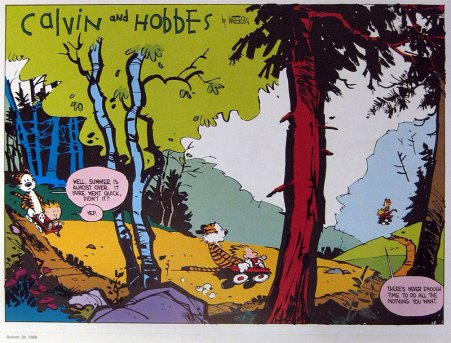
Calvin: There's never enough time to do all the nothing you want.

Do you have enough time to do nothing?
from Bill Watterson, The Authoritative Calvin and Hobbes, p213
Play or Eat? Why not Both?

In What on 26 May 2012 at 1:16 am

Our son turned-over more than a month and a half back and is extremely active – it has become challenging for us to feed him. He wants to play and eat at the same time – any thoughts on how to approach this phase? Also, any ideas on activities for him?
– Appa of a 5 month-old in Maryland

Since he is, as you say, extremely active, I am wondering why you think he is not getting enough food?

Keep in mind that play is a way of feeding the mind, which hungers just as the body does. A baby who knows where the milk comes from and how to get to it, will nurse. Do you think he is playing "too much" and not nursing "enough?" He may think differently. Trust him. Play with him. If you are still concerned that he is not nursing enough, proactively find times & places that are calm and encourage nursing. Use the sling, use skin-to-skin contact, use music. What I found was that taking a walk just around sunset time, with baby in the sling and able to nurse via nursing kurta was very much conducive to nursing and sleeping. Perhaps it resembled the womb. There were a few months when I did this every evening.

Sometimes babies go through phases where they are so keen to play while awake that they save all their nursing for night and naptime. Lest hunger for play take priority over hunger for food, pack in plenty of play so that he is satisfied and works up a good appetite. Play can take the form of singing songs, clapping, peek-a-boo, dancing, bathing (try all at the same time!). Babies also enjoy listening to conversations and watching others work, and generally being involved in whatever is going on. Soon he will be "helping" you with your work. I would recommend that you get a toy phone, preferably one that looks like a land line, and avoid exposure to the cell phone for as long as humanly possible. Likewise I would keep him away from any screen of any size.

Toys like rattles, cups, balls, socks are fun, but leave some scope for him to discover his own playthings. You will discover the hidden wonders of many ordinary things around the house.

What to teach one year old?

In What on 11 April 2012 at 4:37 pm

I want to do some fun activities to spark my 13 month old son’s curiosity. I have him identify parts of body, colours, fruits and animals. I am happy with the way he picks up new things. He can not say the words such as apple but he can point to it if we ask him. What else can I do?
– mother in Visakhapatnam
(From India Homeschoolers)

What are the things he likes to do, with little or no suggestion? Few of us can be more curious than a 1 year old so just leaving time and space for him to explore & express will open up worlds of fun. Space is not only physical, also mental …. so if I may suggest, giving lists of things by category may curb exploration. Being surrounded by people already using names for things in fixed ways, kids are bound to pick up on these … but another, quite fascinating thing that kids do is to come up with original names and categories.

Like your son, my daughter also started pointing to hair, tummy etc and other objects well before she could talk and we never tired of asking her to do so. In retrospect, though I wonder if we should have slowed down.

Other fun activities I remember from when mine was around that age … singing, clapping, stomping, hide-n-seek with objects, blankets, playing with water/ mud, playing with kitchen vessels, “helping” in kitchen, washing vegetables, mixing dough, sweeping, washing, etc. And of course, messing!

Am I academically fit to homeschool?

In Yes / No on 11 April 2012 at 4:36 pm

Do you think you need to be updated in academic subjects to homeschool your child?

– mother of a 2 year old in Pune

The short answer is: No. Many seasoned homeschoolers elaborate on why this is so, reminding you that:

– You are learning together.
– You are not so much teaching what you know as you are supporting their learning whatever they want to learn
– your children will learn how to learn, to delight as they discover, and to navigate the ocean of knowledge, not just acquire a subset of your knowledge.

When the rubber meets the road, however, doubts can creep in. Read the rest of this entry »

Birthday party – let them eat cake?

In Yes / No on 11 April 2012 at 4:34 pm

Till now my son’s birthdays have been family affairs but this time we’re inviting his friends to a party in a park, taking a home-made cake without added sugar. My cousin says this is not a “real” birthday party and guests will be disappointed. Of course I want everyone to have fun, but without the junk.  Am I asking too much?

– mother of a soon-to-be 4-year-old in Delhi

Chetana Amma has written about today’s birthday parties and how to fill them with simple pleasures.


Videos for toddlers?

In What on 27 October 2011 at 3:49 am

What video should I show my toddler? There are so many out there that teach shapes, concepts, math, music, etc.
– father in rural Andhra Pradesh

No video can teach a baby more than free exploration of the world. There is no such thing as educational video for toddlers. In early childhood, when senses are rapidly developing, kids need to experience the world live.  While a little staring-at-screen may be harmless, you will have to ask yourself at what age you can introduce TV / video without it becoming a habit. The topic keeps coming up in various forms, e.g. a recent article “Parents Urged Again to Limit TV for Youngest.” (My comment: 228).

Fortunately screens were not in everyone’s pockets when my child was little, but today it is harder to limit exposure to these. Even if parents keep them away, friends, visitors, even bystanders on a bus find it entertaining to show babies funny things on their latest gadgets. Little ones in turn start expecting it, as if these devices were made for this purpose. Whatever happened to silly songs, funny faces and peek-a-boo? Now there is an app for that??

Sharing with playmates?

In How on 26 September 2011 at 8:31 am

My toddler is less than generous about her things –toys, books etc. with others of her age group (though she loves to share food). How do you develop attributes of sharing, caring, and being sensitive to others’ needs in an infant/ toddler?

When babies’ needs – which are simple and few – are met fully and joyfully, they live in abundance, without a sense of scarcity or hoarding. This shows in your daughter’s generosity with food. Since I have seen otherwise, I don’t believe the oft-repeated theories stating flatly that toddlers are too young to share.

If anything, I find that selfishness and "it’s mine" are learned behaviours. I have actually seen kids who, puzzled by such behaviour, looked to their elders, and were told to respond in kind: "If he doesn’t give you that toy then you tell him this one is yours and he can’t have it." They believe that they are helping their children toughen up.

When other children played with my daughter’s toys, I would encourage her to take it as a compliment – "your ball is so much fun, that others also like to play with it." When other children rode her tricycle, I heard her say the same, "my tricycle is so nice, everyone rides it!" I also tried to model sharing and sensitivity by speaking as I would like to be spoken to, or better still, as I would like her to speak to others.

What toddlers may be too young for are other toddlers. Many children play better in mixed-age groups. Though all of us have seen how well a 1 year old plays with a 4 year old, a 2 year old with a 5 year old, etc, we still find organized playgroups sorted into narrow same-age groups. Amma has decided to simplify this for you with a formula: the playmate for a child of age x should be age y, where

y = x + 4x / (x+1) +/- x^(1/2)
for ages 6-8 use: y = x + 4x / (2x+1) +/- x^(1/2)

Note: x^(1/2) means "square root of x"

So we get the following values

x y

1 3 +/- 1

2 4.6 +/- 1.4
3 6 +/- 1.7
4 7.2 +/- 2
and so on. Parents can customize this formula by introducing a coefficient a to the square root 😉 364

baby learning

In When on 14 June 2011 at 3:28 pm

Even though it’s probably early to think about these things for our daughter …. I wanted to ask to you about homeschooling or self-learning in general.
– Mom of a 6 month-old in Mumbai

It’s never to early to entrust your child with time, space, freedom and respect, and to
observe how she expresses herself, makes choices, and explores. Respond when she calls. Include her in your work and conversations. Include yourself in hers. Clear the way and let her roam, touch, bang and use all her senses to seek knowledge and experience. If you don’t want her to touch (or taste) it, keep it out of reach. Ensure that there are plenty of real things (e.g dishes, buckets, water, mud …) and not just toys that she can touch. Say yes often so it becomes natural. If you have to remove her, "That is unstable, let me find a stronger chair that you can climb" gives more information than "don’t do that." Much is conveyed by your tone, and babies often start understanding words sooner than they let on.

Challenge yourself to learn from her as much as she learns from you. Listen. Alfie Kohn writes about the hazards of “blurting out judgments of our children” – the reasons he lists apply to much more than the beleaguered “good job.”