Ask Amma

Posts Tagged ‘culture’

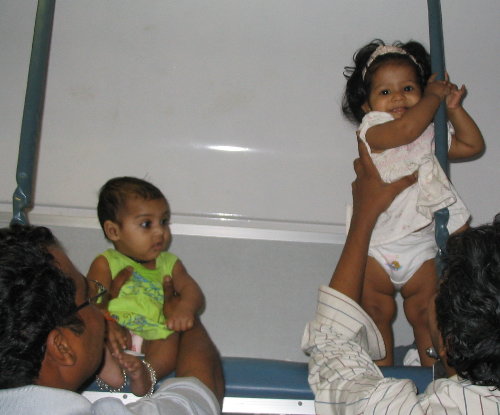
Baby on the train – whom to sensitize?

In How on 11 April 2012 at 4:37 pm

While it is ok for D’s experiments to carry on at home with full freedom, what about outside where other people are not as tolerant? Do I need to restrict her when she is being a little bit too friendly for other people’s liking? Whom do I sensitize – my baby or the other passengers?

– mother of a 2 year old in Bangalore

The message I sense that you are getting from these passengers is, “Control your child, this is not a playground.” Your daughter is thinking, this is way better than a playground – it moves, and there are so many more people to play with! If you agree with her, find more people on the train who share her view and let them play to their hearts’ content. On an overnight journey, try to ensure that she gets enough play during the day so that she is ready for bed at night when passengers are sleeping.

Babies enjoy the Indian Railways … especially the upper berth!

Babies enjoy the Indian Railways … especially the upper berth!

Read the rest of this entry »

Birthday party – let them eat cake?

In Yes / No on 11 April 2012 at 4:34 pm

Till now my son’s birthdays have been family affairs but this time we’re inviting his friends to a party in a park, taking a home-made cake without added sugar. My cousin says this is not a “real” birthday party and guests will be disappointed. Of course I want everyone to have fun, but without the junk.  Am I asking too much?

– mother of a soon-to-be 4-year-old in Delhi

Chetana Amma has written about today’s birthday parties and how to fill them with simple pleasures.


How do you know? So what?

In How on 27 October 2011 at 3:46 am

ऐसा तोड़ी न हो सकता है … It’s impossible to climb Mt Everest?
आप को किस ने बताया? – How do you know?
तो क्या? …. So what??
कुछ भी बोल रहे हो! ….you’re bluffing

Everything credible is being questioned? Everything authentic is being invalidated? This is a new defiance that I hear in my child….he’s been now 2 months in this mode…what’s breeding here?

– mom of 7 year-old in Maharashtra

Ah, age 7. I remember it well. Reminded me of age 3.5, when the pain of realizing that some things in this world just make no sense seems to have turned upside down the rational world of my earnest little child. We have no answer for that angst. But just because we have stopped asking Why? for so many things, how can we say they should too?

Let me guess what might be prompting your 7-year-old’s questions:
– he wants to test the limits of "facts." Who decided these anyway?
– he wants to know how we know things, and this may be more important to him than the "facts" themselves.
– others seem / claim to know things he does not and he wants to level the playing field, challenge them on what they know

– he gets asked similar questions by friends
– he is going through an "information spurt" where he is getting exposed to a stream of "facts" from people, news, books, media and wants to set up some accuracy and relevance filters, kind of like his own toll both on this superhighway.

As I said, above are only guesses. But I congratulate him on his investigative spirit. If he rejects, for example, the idea that the earth is round, let him keep his search open until he is satisfied. Next time you are on the seashore let him observe the ships coming over the horizon. You need not bring up the shape of the earth, he can if he wants. Probably the specific question was not as important as establishing his right to search for answers himself, rather than accepting facts as stated.

And most (all?) facts hold only within certain conditions – how many times have I said something like "that will break if it falls," only to hear my daughter reply, "not if it falls from 1 centimeter" and promptly demonstrate the same. While the talkback can get annoying, would you actually want the thinking behind it to stop?

Cow’s milk for babies?

In What on 26 September 2011 at 8:33 am

We get our fresh cow’s milk from our neighbour and she uses no oxytocin injections or other such chemicals. I’m aware of research from the west that finds against giving cow’s milk before 12 months, and that there is a risk of anemia and allergies but do you think this applies to Asian babies or in communities where cow milk consumption is highly prevalent? We would like to cut back on formula and thinking of introducing cow’s milk when our baby turns six months old, as many other rural families in Himachal Pradesh do.

– nursing mother with low supply

So sorry to hear about your supply difficulties.  Your concerns about formula milk ring true to me.  First let’s look at iron.  Studies show that the percentage of iron that babies absorb from milk is 50-75% for breast milk, 10% for cow’s milk and as little as 4% for formula milk.

I would first try to find milk from another human mother who was willing to supply.  She could nurse your baby or you could provide a pump and then feed the expressed milk by bottle, spoon or cup to your baby.  In exchange you could offer fruits or other goodies that would be helpful for the donor’s family.    La Leche League and Eats on Feets are groups that can help facilitate mother-to-mother milk sharing.

Second, the question of allergies that may arise from early introduction of dairy products.  To assess the risk level, before introducing milk from another animal, such as cow or goat, I would introduce a few drops on the skin and then by mouth, and increase gradually. At the first sign of allergic reaction or other problem I would slow down or stop entirely.  You can also test for dairy allergy if you are in doubt.    If he is not allergic to it, then even if the iron is poorly absorbed, there may be other nutrients in the milk that he will absorb.  Certainly the freshness of the milk available to you and the diet and exercise that the cows enjoy locally makes a difference, and you may want to look into raw milk as well.

At the same time I would also gradually increase the entire range of fruits, vegetables and grains in baby’s diet.

Sources: Dr. Sears  Nutrient by Nutrient
Mayo Clinic Milk Allergy Test
J Pediatrics 1977 Jul;91(1):36-9.  Iron Absorption in Infants

Sharing with playmates?

In How on 26 September 2011 at 8:31 am

My toddler is less than generous about her things –toys, books etc. with others of her age group (though she loves to share food). How do you develop attributes of sharing, caring, and being sensitive to others’ needs in an infant/ toddler?

When babies’ needs – which are simple and few – are met fully and joyfully, they live in abundance, without a sense of scarcity or hoarding. This shows in your daughter’s generosity with food. Since I have seen otherwise, I don’t believe the oft-repeated theories stating flatly that toddlers are too young to share.

If anything, I find that selfishness and "it’s mine" are learned behaviours. I have actually seen kids who, puzzled by such behaviour, looked to their elders, and were told to respond in kind: "If he doesn’t give you that toy then you tell him this one is yours and he can’t have it." They believe that they are helping their children toughen up.

When other children played with my daughter’s toys, I would encourage her to take it as a compliment – "your ball is so much fun, that others also like to play with it." When other children rode her tricycle, I heard her say the same, "my tricycle is so nice, everyone rides it!" I also tried to model sharing and sensitivity by speaking as I would like to be spoken to, or better still, as I would like her to speak to others.

What toddlers may be too young for are other toddlers. Many children play better in mixed-age groups. Though all of us have seen how well a 1 year old plays with a 4 year old, a 2 year old with a 5 year old, etc, we still find organized playgroups sorted into narrow same-age groups. Amma has decided to simplify this for you with a formula: the playmate for a child of age x should be age y, where

y = x + 4x / (x+1) +/- x^(1/2)
for ages 6-8 use: y = x + 4x / (2x+1) +/- x^(1/2)

Note: x^(1/2) means "square root of x"

So we get the following values

x y

1 3 +/- 1

2 4.6 +/- 1.4
3 6 +/- 1.7
4 7.2 +/- 2
and so on. Parents can customize this formula by introducing a coefficient a to the square root 😉 364

What Santa Brings

In What on 25 December 2010 at 1:40 pm

Do your children believe in Santa? If not, how to reply to "What is Santa bringing you?"

Ask Amma excerpts the answer posted here below. You may read the celebrated 1897 reply here.

The spin given to "being good" and "getting presents" (esp the linking) is irksome, but one can deftly undermine it – if asked, "What is Santa bringing you?" why not just say, "a White Christmas!" or "comfort and joy," "great times with my family" and the like. That should bring a smile to all.

The art of replying to questions with ease serves all parents well, but especially those of us swimming against the current. Whether the question is "Are you still breastfeeding?" or "Are you still carrying her?" or "Is he still sleeping in your bed?" the simple answer usually works: "Oh yes!" with a bright smile.

Autonomous worlds of imagination

In Why on 17 October 2010 at 4:04 am

Thanks to Sonika for sharing this excellent article, Old-Fashioned Play Builds Serious Skills by Alix Spiegel, National Public Radio, February 21, 2008. I am so glad that I discovered, somewhat ironically, that “less is more” and even “nothing is better than something” from a toy-vendor website.  That toy vendor was up with the progressive, holistic approach to play and had low-feature, high-imagination-stimulating “waldorf dolls” etc and actually wrote ” your child does not need toys.” It was just what I needed to hear.  Relieved from my search for “brain-stimulating” and “creativity-inducing” toys I was free to accept invitations to the imaginative worlds my daughter was engaged in making up already.


Spiegel comments: “But during the second half of the 20th century, Chudacoff argues, play changed radically. Instead of spending their time in autonomous shifting make-believe, children were supplied with ever more specific toys for play and predetermined scripts.” Read the rest of this entry »

Can Preschoolers Be Depressed?

In Yes / No on 26 August 2010 at 8:03 pm

To share personal stories takes a great deal of courage and one must be prepared for all the comments from parents and nonparents alike.  Here I am sharing the comment I posted on the article that appeared in the New York Times, “Can Preschoolers be Depressed?” As I read the article I could not help but be reminded of Alfie Kohn and his advice – do not be in a rush, do not over-schedule – and his warning against “counting” and other supposed “disciplinary” techniques.  The photos at the top of the article seem to answer the question – yes, if they are all alone in a room full of toys.

Can Preschoolers Be Depressed?

By PAMELA PAUL
Published: August 25, 2010
  1. Comment“He always wanted to please.”
    “rarely disobeyed or acted out.”
    ” If he dawdled or didn’t listen, Raghu (also a nickname) had only to count to five before Kiran hastened to tie his shoes or put the toys away.”
    Though you quote these lines approvingly at the opening of the article, I read them, particularly the last one, as clear warning signals.

    The counting technique to produce obedience, which although popular nowadays is yet another way of making a child feel inferior. Sadly, he is praised for his perfect response to it. Reading on about the Legos, Disney World, and the mother who “ferried him from one child-friendly place to the next” made me feel claustrophobic.

    The comments about the trip to his grandparents’ farm and the vacation in Spain as the happiest times in his life suggest the need for more leisure, less scheduling, less expectation and less monitoring.

    I congratulate this family for seeking help and hope their story inspires more families to give children time, space and unconditional love.