How often do we hear that children won’t eat? No one loves this message more than the food industry, which is ready to jump in with factory-tested flavours and bliss points, adding salt, fat and sugar, flavor, color and stabilizer in indsutrially calibrated quantities to design foods that hold mass appeal. “Kids today don’t eat food!” declares an advertisement for a popular packaged meal. On the screen we see a child pushing away a plate of vegetables, dal and roti and brightening up considerably when the packaged bliss comes forth in steaming digitally enhanced ringlets.
How often have we seen parents or grandparents run behind a child with a bowl of food or hire someone to perform this task? Read the rest of this entry »
I have been referring to granola so often that I realized I ought to post a recipe. I have been making this granola since I was eight years old. Here is the original recipe that I had taped to the wall in our kitchen in Beech Grove.
Ingredients:
3 cups rolled oats
various nuts and seeds, 1/4 cup each
3/4 cup wheat germ
1/4 cup honey or molasses or maple syrup
1/4 cup oil
1/4 tsp vanilla
1/2 cup raisins, chopped dates or other dried fruit.
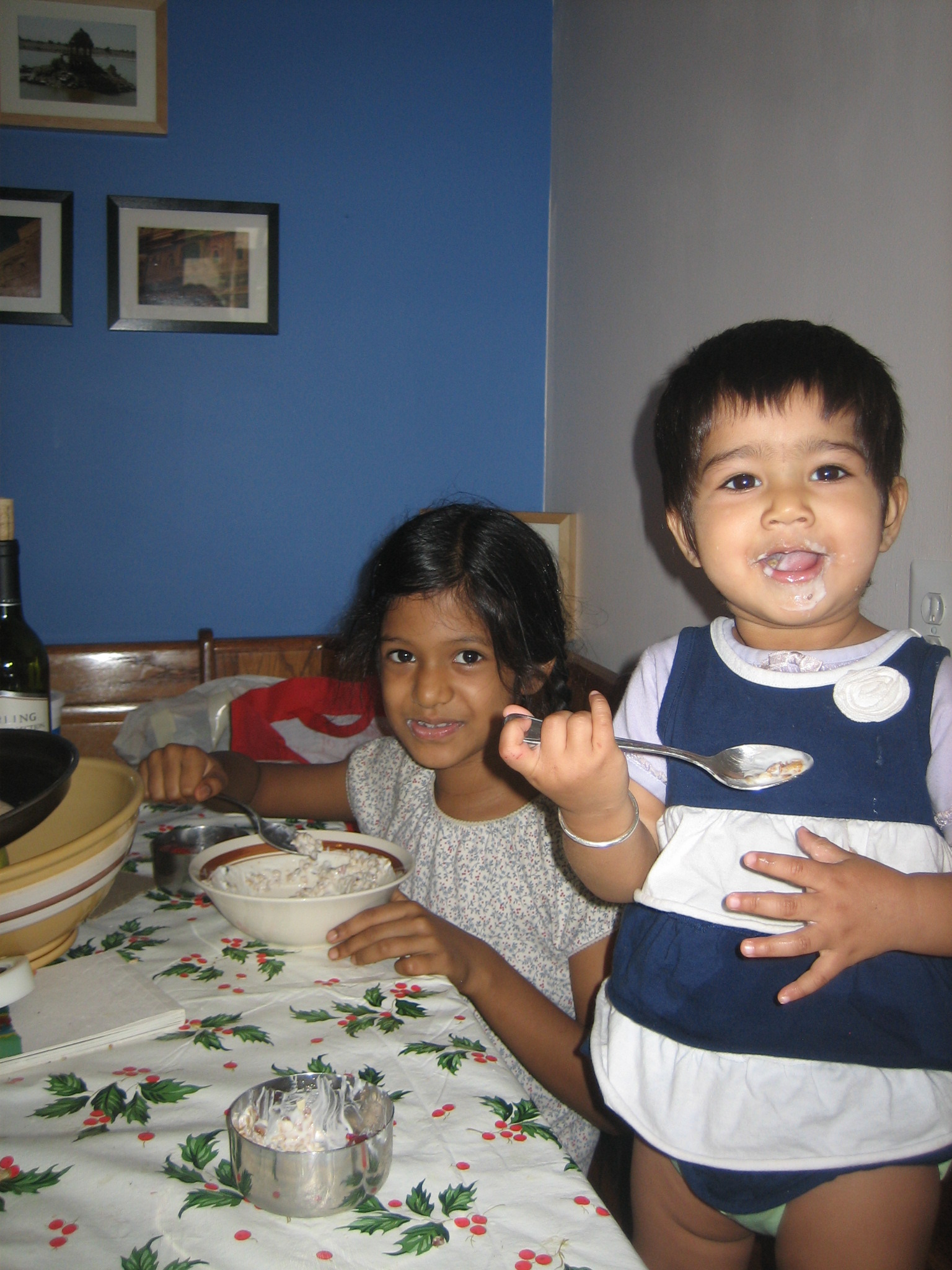
Yummy in my tummy! Granola with yogurt.
Instructions:
Mix oats, nuts, seeds and wheat germ.
In a pot, heat oil, honey and vanilla and stir well. Pour over the mixed dry ingredients and mix throughly. Spread onto large baking pans.
Bake at 300 degrees for 20-30 minutes stirring every 10 minutes to prevent burning. When done granola will be golden brown and make a crisp sound when you stir it.
Allow to cool and mix in the raisins, dates or other dried fruit. Store in an airtight jar or sealed container.
Eat with chopped fresh fruit and/or yougurt or milk. Can also eat with applesauce or all by itself.
* * *
Notes: Generally I used almonds, peanuts and sunflower seeds. If we had cashews or walnuts I threw those in too. Sometimes even sesame seeds.
I usually tripled the recipe, sometimes more. So I started with 9-18 cups of oats. It keeps well for a few weeks.
Over the years, I have modified the recipe.
My mom told me that I could make it chunky by adding some whole wheat flour and water at the end and just scooping up fistfuls and chunkifying them.
If you make and eat it the same day you can skip the oil and not miss it.
Throughout my childhood I loved the step of heating the oil and honey, mostly because I loved to watch it bubble. Later I realized however that this step could easily be skipped.
The vanilla is optional, as is almost everything – except the oats!
In fact, I recently jotted down the recipe to send someone, and this is how it goes:
12 cups rolled oats.
3 cups wheat germ
1-2 cups sunflower and/or pumpkin seeds
1-2 cups of chopped almonds, cashews, walnuts, and/or pecans
1-2 cups raisins and/or chopped dates. If your store sells date pieces like these, then you don’t have to chop!
1/2 cup oil
1/2 cup honey or molasses or maple syrup
optional: 1/2 tsp vanilla
optional: wheat bran or oat bran
For chunky texture, you will need a cup or so of flour and some water to work in after mixing up all the rest of the ingredients.
In keeping with the crunchy nature of granola making, the photos below come from my most recent batch, which I started with 18 cups of oats.
Add sunflower seeds
Chop 2 cups of almonds and add.
Add 2 cups cashew pieces
Add 18 ounces honey.
Add 1 cup safflower oil
Bake at 350 degrees fahrenheit, stirring every 10 minutes till done.
Remove from oven when golden brown, let cool before packing
We started with 18 cups of oats and now have 27 cups of granola!
While the article raises useful points, it unfortunately retains a top-down approach of parents dictating to children or experts dictating to parents. This will not work. What will work is for parents to trust their children from birth. They neither need to tell their children to eat nor tell them not to eat.
The article touches on the importance of breastfeeding, starting with exclusive breastfeeding for the first 6 months, but does not recognize the full scope of breastfeeding to help nurture good eating habits. Read the rest of this entry »
(Jakarta, June 7, 2013) Cheers of “Hooray for peasant women! We are the mothers of food sovereignty!” launched the IV Women’s Assembly of La Vía Campesina
Which sugar substitute is best? Dates, molasses or honey? I quit using agave. – mother of two in Dallas
(a) is a whole food so I will go with (a).
I use any of these three, depending on the context. If you can get raw honey it is supposed to have beneficial properties that are destroyed in the high-temperature processing of the commonly available honey.
I haven’t used ragi ever …and till now I thought it was something like other grains – just buy it and cook it. All this sprouting thing is confusing me. Can anyone please explain how its done? Or how can I introduce ragi to my daughter? Do I need to sprout it?
– Krishna, mama of a 14 month old in Delhi
You can cook whole ragi directly, in upma and other preparations, but as a baby food, it is typically ground into flour and made into porridge.
You can eat it without sprouting, but sprouting improves its nutritional value. Some (like me) also prefer the taste of sprouted ragi flour.
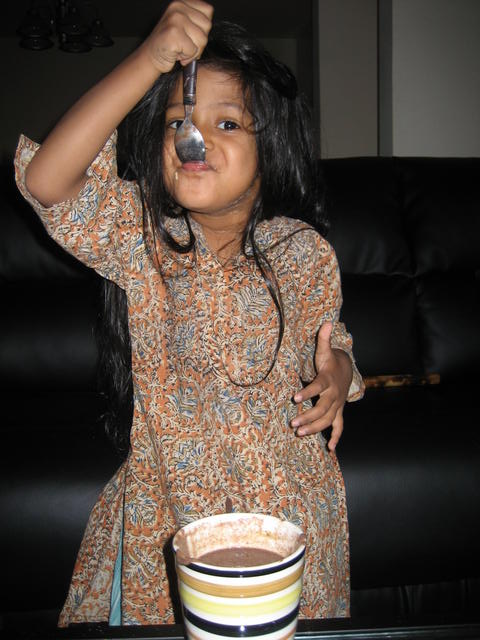
Yummy! Ragi in a Cup
In rural households, sprouting ragi at home is part of the routine work in the kitchen, just like cutting vegetables or making yougurt – even though one can buy ready-made yougurt or pre-cut vegetables in the urban supermarkets. You will retain more nutrients and flavour if you buy your ragi whole and process it at home. When my sister bought a flour grinder, I could easily taste the difference between bread baked with flour ground on the same day as compared to week-old flour. Renewed interest in slow food has inspired urbanites to learn from their rural cousins. Here is a beautiful site explaining how to sprout the ragi at home.
You can also buy sprouted ragi flour. Our first packet came from a company called Dharani (Bangalore) and later we got it from Ecofarms, based in Yavatmal, or Conscious Foods (Mumbai) and now from Satvika, just a hop skip and a jump from us in Chembur. In short, sprouted ragi flour is sprouting up everywhere 🙂 As more urban folks are becoming aware of its nutritional value and also forgetting the art of sprouting at home, the price of sprouted ragi flour has steadily risen and currently in Naturally Yours, our local organic shop in Chembur, the price is Rs. 70 for 500 grams. Whole ragi comes for Rs. 49 per kilogram.
Since ragi absorbs some water during the sprouting process, you will need to add less water when cooking sprouted ragi flour than when cooking unsprouted ragi flour.An internet search quickly yields several recipes for ragi porridge but all of them involve additional ingredients that we do not want to include in baby’s first food.
This ragi porridge is so simple it hardly merits a recipe, but then some people won’t believe it can be done so simply unless they see it described in loving detail on an internet site, so here we go.
Khiyali demonstrates how to make ragi porridge.
Ingredients
1/4 cup ragi flour or 1/3 cup sprouted ragi flour.
1 cup water
Instructions:
In a pot, mix the ragi flour with cold (room-temperature) water. Stir vigorously with a fork till it is nicely dissolved and there are no lumps.
Slowly bring to a boil over medium flame, stirring continuously. As it comes to a boil, it thickens. Once the ragi is thick, remove from flame and let sit for 10 minutes.
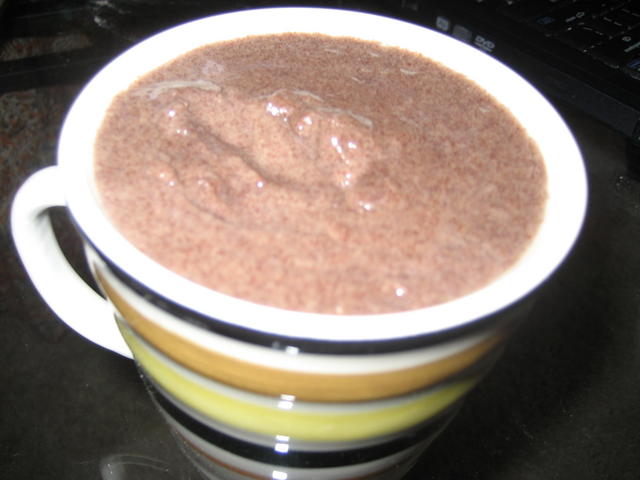
Ragi Porridge in a cup
If you prefer a thicker porridge, you may increase the ragi by a spoon or two – just play around till you have the consistency you like. To get a thick porridge using sprouted ragi flour, I usually use 1 cup flour with 2 cups water, as demonstrated in Ragi Porridge: the video.
You can double the water if you want to have it as a drink.
For babies, this is ALL you want to use. No salt, sugar, milk, or nuts. Eaten fresh and warm, this is a satisfying porridge all by itself.
Why do we not add anything else?
Here are some reasons for avoiding the following common ingredients, when preparing food for babies and young children.
Milk – Babies absorb iron from breastmilk very well, especially when no other sources of iron are in the stomach at the same time. So don’t mix baby’s ragi with breastmilk – that will lower the absorption of iron. Don’t mix it with cow’s milk either. Ragi (especially sprouted ragi) is high in calcium and iron, and cow’s milk makes it more difficult to absorb iron from foods (See Iron Deficiency). For human babies, (other) animal milk is nutritionally inferior to mother’s milk and also inferior to ragi. Why fill baby’s stomach with an inferior food?
Nuts – In light of the rise of allergies particularly in Western countries and other parts of the world adopting Western lifestyles, a number of health specialists recommend delaying nuts till age 2, and in particular delaying peanuts till age 3. One must be even more cautious if there is a family history of allergy. Even nursing mothers are advised to avoid nuts until the child is old enough to have nuts. If you aren’t living in a western lifestyle, and have no family history of allergies you may take this caution with a grain of salt, as it were.
Added salt – Give your baby a chance to taste food as it is, without added salt. Salt has its place and there is nothing wrong with eating it but one should not depend on salt to make food tasty. One should be able to enjoy the taste of plain vegetables or grains. Delaying salt till at least 12 months allows the palate to grow accordingly.
Added sugar – same logic as above. Let babies and children taste the flavours already there in foods, without depending on added sugar to render things sweet. By delaying added sugar till age 4 or 5 years, one can get used to a variety of flavours, build healthy eating habits, and also diversify one’s repertoire for desserts and treats that use the sweetness already there in fruits and other whole foods.
Many babies eat plain ragi porridge quite happily. Once your child is chewing you can try adding fresh or dry fruits if you think s/he would like that. I usually saved the fruits to have as a snack at some other time of day. After my daughter started having nuts, I would add raisins or dates and crushed almonds to the ragi porridge and she liked that too. In fact she still does 🙂
Video: EZ Cooker is good for ragi too. Of course even on the stove it cooks quickly, but you can shave a minute or two off the stovetop time by transferring to the EZ cooker once it starts to boil. Once it is in the EZ cooker it cannot burn or boil over. It will not thicken as much as it would on the stove but if you like a softer porridge this is just right.
Though I believe in giving choices I am concerned about how we offer choices with information and help children understand consequences that follow. So I come back to the basics to understand what choices actually are.
Is a choice:
– to offer a child two snacks and letting him pick on his own? (The snacks are decided by us.)
– or to let the child choose something from whole pantry itself.
– or, when a child wants sugar or desserts (too much of which we don’t want in their food) to offer apple, grapes etc instead of sugar or desserts.
– Amma of a 3 year-old in California
Before coming to the specific question on choice of snacks, let us look at the general question of offering choices. Read the rest of this entry »
My daughter hardly eats anything. She breastfeeds and has around 250 to 300 ml of milk a day – that’s it. She just doesn’t want to eat any solids. She sometimes obliges me but it happens only once in a blue moon. She used to have home made baby food earlier but now seems to have an aversion to anything and everything. She has not gained any weight in past 2 months. Please help me out …I’m so worried 😦
Dear friends, we have talked about food security, food traditions and the rise of industrial food, packaged food, food-substitutes. Often these are based on false advertising, unverified health claims, pseudo-science or violation of advertising standards. This is true not only in India but around the world – but in countries where regulations are regularly updated and enforced, these ads are challenged and in some cases banned.
Readers, now is the time to collect every specimen you can find of advertisements and promotions for “baby food.” This includes
breastmilk substitutes – infant formula
complementary food substitutes – other powders and edible food-like substances that are marketed for young children in lieu of breastmilk and solid food.
What you need to do: Find these ads in any language and submit them to Nupur Bidla at nupur@bpni.org
who will present on this issue at the World Breastfeeding Conference taking place in Delhi this December. Deadline is Sept 20.
While we will try to collect as many as we can from India, but please note that this is a GLOBAL conference – the ads may be from ANY COUNTRY.
You may use the attached Submission Form to indicate where the ad appeared and what inappropriate content was included.
The Advertising Standards Authority (ASA) of UK commented:
“The health and nutritional claims made by GSK and Nestle may be allowed in other parts of the world, but they breach the strict rules in the UK and we have seen no evidence to substantiate them,” he said.
Yet these ads continue to air unchallenged in India today.
I hope that this effort to document the appearance of these ads will encourage more fact-checking and will compel the government to enforce standards for advertising in India.
Deadline is 20 Sept 2012. Please use the attached form to send in the copies of ads that you find. A sample ad with the inappropriate claims highlighted is included in the form.
Many of you have asked me how we can fight false advertising of the packaged food and food-substitute industry. Please let us make use of this invitation from the World Breastfeeding Conference.
enclosed: Letter from Breastfeeding Promotion Network of India Member (cover letter to submission form)
Dear Friends,
Greetings from BPNI!
There is good news for you!!
Deadline for Submitting your entry for the “ATLAS of Baby Food Promotion” has been extended.
Now you can submit /report your contribution by 20th of September 2012.
To send your entry please click here to see the guidelines.
We wish you could be a part of this historical Atlas, we would be happy to hear from you through a confirmation mail.
Warm Regards,
Dr. Arun Gupta MD FIAP
Regional Coordinator IBFAN Asia,
Member, Prime Minister’s Council on India’s Nutrition Challenges,
Phone 91-9899676306
Seeing how difficult it is to move to whole grains after being used to everything white from rice to bread to semya, nan, pasta, etc, I wanted to make it easier for my children by serving whole grains from the start. Recently a friend told me that giving brown rice cereal as first food is not as good as giving white rice cereal, because of the phytic acid issue (the brown rice contains more phytic acid than white). Now I am confused, what should I do?
– Mother of 4-year and 4-month old in Mysore
Several issues are bundled up in this question. First food, digestion and nutrient absorption, and food preparation. And brown rice. Amma is ready 🙂
First, first food. Obviously the “first” in question is not breastmilk, which is normally the first and only food for babies for at least the first six months of life. Six months is not a fixed target for the entrance into solid foods. These days when deadlines and schedules seem to hover over everything people often forget that a baby’s readiness for solid foods depends on maturity of the digestive system, and there is no benefit to introducing solids before a baby is ready for them. Read the rest of this entry »
Send your questions on health, hygiene, learning, discipline, sleep, sanity, serendipity, chaos and any other aspect of parenting, real or imaginary to askammanow@gmail.com




 Ask Amma