Brushing teeth is something that we tend to do at times of the day when we have one eye on the clock, be it for eating breakfast and getting out of the house, or for getting to bed.
For those who are yet new to the task of teeth-brushing, and who may not be particularly keen to get out of the house or to get to bed, what incentive is there to brush? Let alone to brush quickly – hence leading the time-sensitive parent to conclude “he won’t brush.” Maybe your son needs more time to brush, and for brushing to be more fun and meaningful. Explain in a matter-of-fact, non-threatening way, why we brush our teeth and try to incorporate tooth-rushing into a pleasant family routine.
Here are some more things you can try:
1) Say something like: “Hey Lou, it’s party time! Junior just ate some yummy food and some of it is still there around his teeth. Call all your friends and let’s get some! Those are the bugs talking, they are coming to eat some food and multiply. They are in for a shock when the toothbrush comes in!”
2) Brush each other’s teeth.
3) Put the tooth powder / tooth paste on each other’s tooth brush.
4) Brush at a time of day when you aren’t in a rush.
5) Diversify your teeth cleaning methods so that the pressure is not on brushing alone. Swish with water or eat apple, carrot or celery, especially after sticky or crumbly foods.
Most of the above come from our own experience. Now it all seems so long ago!
Gentle reader, what are some ways you have encouraged toothbrushing? Please comment and share your tips and techniques.
I haven’t used ragi ever …and till now I thought it was something like other grains – just buy it and cook it. All this sprouting thing is confusing me. Can anyone please explain how its done? Or how can I introduce ragi to my daughter? Do I need to sprout it?
– Krishna, mama of a 14 month old in Delhi
You can cook whole ragi directly, in upma and other preparations, but as a baby food, it is typically ground into flour and made into porridge.
You can eat it without sprouting, but sprouting improves its nutritional value. Some (like me) also prefer the taste of sprouted ragi flour.
Yummy! Ragi in a Cup
In rural households, sprouting ragi at home is part of the routine work in the kitchen, just like cutting vegetables or making yougurt – even though one can buy ready-made yougurt or pre-cut vegetables in the urban supermarkets. You will retain more nutrients and flavour if you buy your ragi whole and process it at home. When my sister bought a flour grinder, I could easily taste the difference between bread baked with flour ground on the same day as compared to week-old flour. Renewed interest in slow food has inspired urbanites to learn from their rural cousins. Here is a beautiful site explaining how to sprout the ragi at home.
You can also buy sprouted ragi flour. Our first packet came from a company called Dharani (Bangalore) and later we got it from Ecofarms, based in Yavatmal, or Conscious Foods (Mumbai) and now from Satvika, just a hop skip and a jump from us in Chembur. In short, sprouted ragi flour is sprouting up everywhere 🙂 As more urban folks are becoming aware of its nutritional value and also forgetting the art of sprouting at home, the price of sprouted ragi flour has steadily risen and currently in Naturally Yours, our local organic shop in Chembur, the price is Rs. 70 for 500 grams. Whole ragi comes for Rs. 49 per kilogram.
Since ragi absorbs some water during the sprouting process, you will need to add less water when cooking sprouted ragi flour than when cooking unsprouted ragi flour.An internet search quickly yields several recipes for ragi porridge but all of them involve additional ingredients that we do not want to include in baby’s first food.
This ragi porridge is so simple it hardly merits a recipe, but then some people won’t believe it can be done so simply unless they see it described in loving detail on an internet site, so here we go.
Khiyali demonstrates how to make ragi porridge.
Ingredients
1/4 cup ragi flour or 1/3 cup sprouted ragi flour.
1 cup water
Instructions:
In a pot, mix the ragi flour with cold (room-temperature) water. Stir vigorously with a fork till it is nicely dissolved and there are no lumps.
Slowly bring to a boil over medium flame, stirring continuously. As it comes to a boil, it thickens. Once the ragi is thick, remove from flame and let sit for 10 minutes.
Ragi Porridge in a cup
If you prefer a thicker porridge, you may increase the ragi by a spoon or two – just play around till you have the consistency you like. To get a thick porridge using sprouted ragi flour, I usually use 1 cup flour with 2 cups water, as demonstrated in Ragi Porridge: the video.
You can double the water if you want to have it as a drink.
For babies, this is ALL you want to use. No salt, sugar, milk, or nuts. Eaten fresh and warm, this is a satisfying porridge all by itself.
Why do we not add anything else?
Here are some reasons for avoiding the following common ingredients, when preparing food for babies and young children.
Milk – Babies absorb iron from breastmilk very well, especially when no other sources of iron are in the stomach at the same time. So don’t mix baby’s ragi with breastmilk – that will lower the absorption of iron. Don’t mix it with cow’s milk either. Ragi (especially sprouted ragi) is high in calcium and iron, and cow’s milk makes it more difficult to absorb iron from foods (See Iron Deficiency). For human babies, (other) animal milk is nutritionally inferior to mother’s milk and also inferior to ragi. Why fill baby’s stomach with an inferior food?
Nuts – In light of the rise of allergies particularly in Western countries and other parts of the world adopting Western lifestyles, a number of health specialists recommend delaying nuts till age 2, and in particular delaying peanuts till age 3. One must be even more cautious if there is a family history of allergy. Even nursing mothers are advised to avoid nuts until the child is old enough to have nuts. If you aren’t living in a western lifestyle, and have no family history of allergies you may take this caution with a grain of salt, as it were.
Added salt – Give your baby a chance to taste food as it is, without added salt. Salt has its place and there is nothing wrong with eating it but one should not depend on salt to make food tasty. One should be able to enjoy the taste of plain vegetables or grains. Delaying salt till at least 12 months allows the palate to grow accordingly.
Added sugar – same logic as above. Let babies and children taste the flavours already there in foods, without depending on added sugar to render things sweet. By delaying added sugar till age 4 or 5 years, one can get used to a variety of flavours, build healthy eating habits, and also diversify one’s repertoire for desserts and treats that use the sweetness already there in fruits and other whole foods.
Many babies eat plain ragi porridge quite happily. Once your child is chewing you can try adding fresh or dry fruits if you think s/he would like that. I usually saved the fruits to have as a snack at some other time of day. After my daughter started having nuts, I would add raisins or dates and crushed almonds to the ragi porridge and she liked that too. In fact she still does 🙂
Video: EZ Cooker is good for ragi too. Of course even on the stove it cooks quickly, but you can shave a minute or two off the stovetop time by transferring to the EZ cooker once it starts to boil. Once it is in the EZ cooker it cannot burn or boil over. It will not thicken as much as it would on the stove but if you like a softer porridge this is just right.
Though I believe in giving choices I am concerned about how we offer choices with information and help children understand consequences that follow. So I come back to the basics to understand what choices actually are.
Is a choice:
– to offer a child two snacks and letting him pick on his own? (The snacks are decided by us.)
– or to let the child choose something from whole pantry itself.
– or, when a child wants sugar or desserts (too much of which we don’t want in their food) to offer apple, grapes etc instead of sugar or desserts.
– Amma of a 3 year-old in California
Before coming to the specific question on choice of snacks, let us look at the general question of offering choices. Read the rest of this entry »
After learning the hard way, Amma is happy to recommend the bicycle without pedals for our littlest cyclists. Training wheels, in her experience, hindered rather than helped the process of building balance and coordination. The balance bike lets one learn these skills without the constraint of pedaling. One can also use a regular bicycle as if it were a balance bicycle; simply ignore the pedals. Or remove the pedals – as shown here:
What parent hasn’t shared stories about what their kids do and say? And what parent hasn’t been asked, Are you writing this down? (Or taking audio/video/photo, if one is so deft as to unobtrusively capture the moments.) And what parent has not thought, this is a tiny fraction of all the momentous, insightful and often incredible things that we see and hear from our little one.
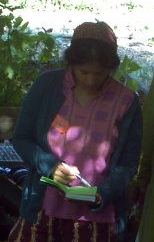
Writing while standing
I kept a pretty detailed journal in the early years of motherhood, but later I found it harder and harder to keep up. Partly because the most attractive feature of the diary, the quiet place where I could be alone with my thoughts and which I could carry around like a book, was also its weakness. Why? I rarely had my diary and a decent pen on hand when I had something exciting to write.
I should confess that once I select a blank journal to be my diary, I use only good pens to pour my thoughts onto the page. I also like to have a place to sit for a nice long time but have had to adjust my expectations.
Typing, in contrast, is not burdened with aesthetic expectations. I found that if I thought of something I wanted to keep, I could type in whatever window was open on my computer at the time. I could dash off an email – maybe to my parents, or to my sister or sister-in-law. Sometimes I would never finish the mail and it would just sit in saved drafts. Or I would not even send it to anyone, just keep saving notepad files with names like may10_tmp.
Then I found a way to turn these various emails, drafts, notepad files and other scraps of text into a diary, all in once place. WordPress! If you sign up for a blog, wordpress allows you to update by email. Just send a email to the unique email id that it assigns you (bcc when writing to family / friends, or their reply-all messages will get posted to the blog as well). The body of the mail appears as a blog post, with your subject line as the title. You can attach pictures and they will appear as part of the post. No need to login! You can set your blog to private if it helps you not to worry about dotting your Is and crossing your Ts. In any case from experience, I can assure you that blogs get no visitors unless you keep publicizing them. (Hint – please let your friends know about askamma!) When you have time you can login and improve the look and feel of the blog – categories, tags, themes etc. You can change the dates of the post to reflect when things actually happened as opposed to when you got around to writing about them. I still have my diaries and pens, and I find my thoughts flow differently when I write on paper. That flow is very dear to me and I try to write as often as I can.
Since babies learn languages easily, I want to fill my home with languages. My husband and I speak three languages, and I thought we could add one more, and find a friend to come over and speak a fifth one – probably Chinese since that is so important globally. Do you think learning 5 languages will be too confusing?
~ expectant mother in Cambridge
Babies learn easily because they learn by doing. They will learn language from someone who is speaking the language, over one who is teaching it. After all, if it were useful, would it need to be taught? Remember that babies also make up language from scratch as if no one had ever done it before, and this bushwhacking through the jungle of sound and sense is an adventure of a lifetime.
If the baby’s environment comprises people using various languages then just as with any other interesting object, baby will pick them up and put them in her mouth. Since English is everywhere, I would urge you to speak your other native language(s) at home.
Little multilingual speakers seem to know which language is which. My parents tell a story about me translating English for Telugu visitors, not realizing that they too were multilingual.
In our family we spoke only Telugu when my daughter was young. Once she learned to read, English leapt ahead. Why? Children’s books with simple words in large print, and computer fonts in all sizes were abundant in English but not in Telugu. All that has changed today. All the languages you speak can go with you when you enter the written world.
What do you think of baby sign language? Will it delay our baby’s ability to learn to speak? – expectant parents in Cambridge
What most encourages a baby to speak is to be heard. Nonverbal communication precedes verbal and continues right along with it. Facial expressions, body language, and hand gestures let us know what our baby considers to be worth telling us and help us to become good listeners.
In early months, you may notice squirms, muscle tension/ relaxation or facial expressions that your baby makes before relieving herself, or when hungry or sleepy or wanting to go outside. Around 8 months we noticed that after completing any task, our daughter rotated her hand. We picked up these signs, devised our own for such common requests as water or open, and also used some ASL signs. She continued to dabble in ASL long after she started speaking.
What should I use to bathe my newborn baby? Her skin seems to be peeling off 😦
– mom of a newborn who is not exactly like her first-born
Newborn skin peeling, while apparently normal, seems to be one of those things that you know will stop, yet, you worry till it does.
Regarding bathing, what I use and recommend for young and old alike is besan, or chickpea flour. Sunnipindi – mung dal (green gram) flour mixed with rice flour – feels even better but requires mixing two ingredients rather than just one. Be it besan or sunnipindi, I simply add water to make a paste, rub on the skin and rinse off. If you leave it to dry for a minute, you have to rub while rinsing, getting the exfoliating effect. Voila – clean, smooth, baby-soft skin. Some people get fancy and mix in yogurt, oats, honey, or dry flowers, neem leaves, orange peels, turmeric etc. So if your little one gets his oatmeal all over his face, he just may be onto the secret of a glowing complexion!
Make sure your oranges aren’t sprayed or your turmeric artificially coloured. An even simpler approach is to use plain water, especially if bath is primarily a time for play and relaxation.
I may have jinxed my ec fun. [My newborn] peed and pooped several times in the sink after a feed but now since yesterday every time I hold her in the ec position she squirms. I didn’t have this with [my firstborn]. Do you think I started too early? Don’t want to put her off.
– mom of a newborn who is not exactly like her first-born
Remember, the “c” in ec stands for communication, not catching. Some ec parents say that when you stop talking about catches and misses, you start listening and observing. Baby is not put off by someone who listens and observes.
Recently a family member told me that I can’t and probably should not tailor make my life around my child. And that my child should figure out “being” around the life that just happens to us. I think this bit of advice is what really got me thinking about the idea of “being” with my child.
Is it possible that I could just let life happen and let my child figure out how to “be” around it?
– Pushpa, mother of a 3 year old in Pune, posted on Swashikshan
Life is always happening. If what you are doing in your life is engaging with (or “tailor making” your life around) your child, that is what your child will “be” around and figure out how to respond to.
I find sometimes kids are really curious about the things we do without them or when they aren’t around (or aren’t awake) and we should do some of those things even when they are there. Of course it helps if we can allow them to “help.” How often it happens that our work *is* the game that our little ones decide they want to play. If we could dissolve the boundaries between work and play, then it would not matter who was responding to whom, and who was figuring out life along side whom. It would be reciprocal. This is how I interpret the continuum concept.
Thank you Pushpa for letting us excerpt your opening question here on the pages of Ask Amma. Readers are encouraged to Pushpa’s article in full, “Being with my Child.”
Send your questions on health, hygiene, learning, discipline, sleep, sanity, serendipity, chaos and any other aspect of parenting, real or imaginary to askammanow@gmail.com





 Ask Amma