Ask Amma

Posts Tagged ‘food’

Baby hungry after feeding, spits up

In What on 17 February 2012 at 5:17 pm

My son drinks about 4 or 5 oz of expressed breastmilk and wakes up in an hour and fusses a lot. He acts hungry but if I try to feed he spits up. He won’t calm down with rocking, singing, diaper change, holding closely or anything else. Doctors tell me to let him cry and feed him once in three hours. If I feed him more often, what do I do about his spit up problem?
– mother of a 10-week old in California

As they say, spit-up is a laundry problem, not a health problem. If baby is gaining weight, don’t worry about the spit milk – it is usually not more than a couple of spoons. As you know, breastmilk is easily digested so there is nothing unusual about getting hungry again after an hour or even less. If the gap is too long the baby may get overly hungry and find it difficult to relax into the feeding.

Does he nap-nurse or nurse while asleep or nurse just as he is preparing to wake up? If you can feed him before he expresses full-blown hunger that may also help – it gives him more time to spend in the state of "quiet alertness" where he is not having to use his energy to get needs met, but can take interest in what is going on around him. There is no need to follow a timetable with regards to feeding, just offer the breast whenever you think of it and soon you will find the right rhythm.

Babies also need a lot of unconditional holding and carrying. And, sometimes, a loving shoulder to cry on. Even if we do not know why they are crying, they should not have to cry alone.

Baby suddenly stopped nursing

In How on 27 October 2011 at 3:50 am

My 4 month old suddenly refuses to nurse. I put him to the breast and he screams … what should I do? I am worried about losing my already low supply.
– new mother in Goregaon.

A pause or “strike” in nursing is not uncommon. Kelly Mom, an essential reference for nursing moms, has a detailed page: Help! My Baby Won’t Nurse! To calm your worries about supply, can you pump while trying out ways to get past this phase?

Could it be that he is not comfortable in cradle position? Could you try nursing while carrying him upright on your hip? I used to do this with baby in the sling so that she could nurse as I walked around or did other things – this way she had interesting things to look at and did not have to sacrifice that for the sake of nursing. Is he gaining new mobility? If he is too busy to nurse while awake, you could try more nap-nursing and night-nursing.

Skin-to-skin contact also helps. If you can arrange some of the times while you are both asleep, or while he is in the sling, to keep your shirt open so that he can latch on by himself without waking all the way up it might facilitate more nursing.

As with many phases, of nursing or of parenting in general, by the time one finds a work-around, the phase itself passes.

How often does a 3-year-old nurse?

In When on 27 October 2011 at 3:48 am

How often does your 3-year-old nurse? My son is 2.5 right now and still nurses ALL THE TIME! At times it is hard – he asks at a most inopportune time and then screams if I say "not now." I don’t want him weaned, I just don’t want him nursing constantly.

This question came up in Mothering, a forum that has helped me consistently. I was so grateful to be nursing when my daughter was 3 because we went through a series of illnesses at that age, as noted in my weaning story (see Announcements below). Just the other day my neighbour in Mumbai confided to me, almost shyly, that she nursed her daughter till age three-and-a-half. Our kids are only 6 months apart, we were both nursing three-year olds in the same neighbourhood, and did not even know it at the time! While chatting with her I learned that her mother and grandmother had set the example for her unrestricted nursing. Hurray for families supporting breastfeeding!

Weaning … and Free Learning

In How on 27 October 2011 at 3:00 am

My weaning story, originally titled “Weaning: Fountain of Free Learning,” was edited and published in Breastfeeding Today, October 2011 here on page 14. I think they did a decent job condensing.  Here is what I wrote in 2009:

Weaning: Fountain of Free Learning

Weaning: Fountain of Free Learning

     We often hear that nursing a baby provides not only food but also love, comfort and immunity.  As a mother, I found it was all this and more.  I discovered breastfeeding to be a quintessential experience of free learning, right up to and including child-led graduating.   Natural, free, unscheduled, ungraded, untested and self-guided, the experience of breastfeeding gives the child far more than nutrition or even the oft-remarked “brain-boosting DHA.”  Reflecting back on nursing my daughter, I find that it gave her precious time, space and context to learn numerous life skills – not only eating, but also ways to understand her body, her mind and the world around her.  No one could give her a certificate that she had learned.  She moved on when she was ready.

*   *   *   *  *

It is over year since my daughter’s last breastfeeding.  She weaned over a period of 2-3 months, as the gaps between nursings became longer and more frequent … and then I realized it was no longer a gap.  It was all.  One June day when I first noticed a gap of more than a week, I couldn’t resist asking my daughter about it, though I was not sure if I was “supposed” to bring it up at all.  She simply said, “I don’t need it anymore.”  (She did nurse a few more times in July and August.)  My husband gasped, “what?  but you are supposed to have ampa (short for amma-palu, which in Telugu means mama-milk).”  They both giggled.

At the time I hardly talked to anyone about it. I have always been vocal about breastfeeding, calmly answering people who were shocked to see me breastfeed and NIP (nurse-in-public) well past the World Health Organization’s recommended minimum of 2 years.  Though I was bursting with it, what time or place to bring up the story?  Most of my family and friends might not have known she was “still” nursing, or even thought about it.   Without planning to, I did pour out to one friend, a fleet-footed newlywed engineering consultant in Washington, DC, whose views on breastfeeding or motherhood I knew not in the slightest.   She listened.   We laughed through moist eyes.   Later one day, entirely by luck, I found myself in the library on the day of our monthly La Leche League meeting.  I shared my experience.  Recently I again attended LLL after more than a year’s gap and a couple of moms remembered my story.  They had understood (of course).

They encouraged me to “write it down.”  And so here it is.

I always knew that I would breastfeed.  My mother was in La Leche League when my little sister was born and I went to my first LLL meeting  (as an adult) while I was pregnant. Though we had difficulties in the beginning, we got established after a few days and nursing was smooth after that.   There were ups and downs, of course.  At nine months my daughter loved idlis (steamed rice-and-bean cakes) so much I worried that she was not nursing enough.  At 15 months there was a time when she did not nurse for more than 24 hours and I worried because I knew that was too early to wean.  At 22 months she was nursing like a baby, waking up every 2 hours at night and all.  (Soon after the nursing spurt she had a growth spurt.)  Through all these ups and downs, I never lost confidence in nursing; moreover I had terrific support from mothering.com/discussions and La Leche League online community forums, even though I knew few nursing moms in real life.

When my daughter was three I observed that she was nursing 3-6 times / day.  To sleep, to wake up, once in the middle, and often a couple of times during the day.  I remember noting that it did not seem to be tapering off in any way.  Could this actually end?

When she was 3 ½, I was most grateful that she was nursing.  That winter she got sick three times in three different places  – Delhi, Bombay, and Rasuru (Orissa), each time with high fever, and once with measles.  Each time she nursed right through her illnesses.  Though she was sick and needed to direct all her energy towards healing, she was not uncomfortable.  Through breastfeeding, mostly in her sleep, she was getting plenty of fluids, rest and nutrients.   She certainly couldn’t keep any food down (we tried that too).

Nursing helped our daughter to develop healthy eating habits.  She ate on her own, right from her introduction to ragi (millet) at 6 months, and soft fruits like banana and sapota, soft vegetables like peas, sweet potatoes, plantain, beets, and onwards to grains, beans, and beyond.  She ate whole grains from the beginning – whole millet, brown rice, whole wheat bread, mung and urad dal were also unpeeled.   We simply served her food and she ate as much as she wanted, with her own hand.  We usually ate together.  If she needed more time she would eat by herself as I took care of other work.  Or read a book.  Eating was always a happy and relaxed experience; never a chore, either for her or for us.  Through mother’s milk she became familiar with the diverse tastes of all that I ate; I think that served as a preview to whet her appetite for the real thing. Since she was breastfeeding I knew she was getting her nutrition so it did not matter how much solid food she ate.  With this freedom she embraced, at her own pace, the array of whole, natural foods we prepared.

Weaning from the breast signified not only a transition from one source of food to another, but also a transition in the way my daughter understood herself and dealt with the world. The basic ability to gauge one’s own hunger and satiety, cultivated at the breast, will serve one well at the plate.  Over the years I came to recognize that breastfeeding offers so much more than nutrition.  It offers immunity not only to germs but also to excessive stimuli from the environment.  It nurtures one’s sense of wholeness, it is comfort after a fall or stress, and of course, it is a warm cozy place to let down one’s guard and sleep.  The world offers alternatives for all of these functions, and the child who learns to avail these at her own pace will utilize them wisely.

Because breastfeeding often required me to take my daughter to work, it allowed her to be in interesting environments observing adults busy in various activities.   Also, it gave adults a chance to share time and space with a child and accept a nursing toddler as normal.  One small step towards building our continuum society.

Around age four, I again noticed that she was nursing nearly every night and sometimes during the day as well.  I wondered how long she would nurse, but did little more than wonder.  Once when she skipped a day I spent hours writing in my journal.  What does this mean?  But the next day she was back; meaning was forgotten.

It started soon after her fifth birthday.  Till then she was going strong with no signs of tapering off.  Two weeks later however, I observed that she’d skipped several days.  Was I ready for this?  I couldn’t say she was too young.  She was even past the oft-quoted “worldwide average” of 4.2 years.  So what was I missing?

Wasn’t I now supposed to be celebrating – increased wardrobe choice, one less mile to go before I sleep?  Sure, there would be plenty of days ahead to enjoy that.  Now I was immersed in a rush of feelings, and savoring that rush.   It passes all too quickly.

The author nursing her daughter at the grand canyon, Arizona.

The author nursing her daughter while on a hike.

Aravinda Pillalamarri, 2009


Cow’s milk for babies?

In What on 26 September 2011 at 8:33 am

We get our fresh cow’s milk from our neighbour and she uses no oxytocin injections or other such chemicals. I’m aware of research from the west that finds against giving cow’s milk before 12 months, and that there is a risk of anemia and allergies but do you think this applies to Asian babies or in communities where cow milk consumption is highly prevalent? We would like to cut back on formula and thinking of introducing cow’s milk when our baby turns six months old, as many other rural families in Himachal Pradesh do.

– nursing mother with low supply

So sorry to hear about your supply difficulties.  Your concerns about formula milk ring true to me.  First let’s look at iron.  Studies show that the percentage of iron that babies absorb from milk is 50-75% for breast milk, 10% for cow’s milk and as little as 4% for formula milk.

I would first try to find milk from another human mother who was willing to supply.  She could nurse your baby or you could provide a pump and then feed the expressed milk by bottle, spoon or cup to your baby.  In exchange you could offer fruits or other goodies that would be helpful for the donor’s family.    La Leche League and Eats on Feets are groups that can help facilitate mother-to-mother milk sharing.

Second, the question of allergies that may arise from early introduction of dairy products.  To assess the risk level, before introducing milk from another animal, such as cow or goat, I would introduce a few drops on the skin and then by mouth, and increase gradually. At the first sign of allergic reaction or other problem I would slow down or stop entirely.  You can also test for dairy allergy if you are in doubt.    If he is not allergic to it, then even if the iron is poorly absorbed, there may be other nutrients in the milk that he will absorb.  Certainly the freshness of the milk available to you and the diet and exercise that the cows enjoy locally makes a difference, and you may want to look into raw milk as well.

At the same time I would also gradually increase the entire range of fruits, vegetables and grains in baby’s diet.

Sources: Dr. Sears  Nutrient by Nutrient
Mayo Clinic Milk Allergy Test
J Pediatrics 1977 Jul;91(1):36-9.  Iron Absorption in Infants

Millet Rotis?

In Yes / No on 26 September 2011 at 8:32 am

About using millets as first foods at 6 months: Should I just use the powders and cook them like porridge? We generally have them in roti form – can we just grind the rotis with milk and give?
– mother of a 6 month old

Don’t mix ragi with milk, esp for infants. The iron in each food is better absorbed if they are digested separately. Simply make the ragi porridge with plain water and add nothing else – no salt, no sugar. In a few months when your baby is able to chew he can enjoy the ragi rotis just like you.

How to feed baby

In How on 14 June 2011 at 3:26 pm

We know what to feed our baby but how do we know how to do it — when, how much, how often?

– dad of a 9-month old in Delhi

One important thing children start to learn after 6 months of age is how to gradually complement mama-milk with the wide world of food. Not all babies are ready at 6 months either. Just as a child comes to the breast and directs his own feeding, so can he be trusted with solid foods. Simply serve the food and let baby eat on his own. He will decide whether, when and how much. If you think that he wants or needs help feeding himself, let him take the lead by either pulling your hand / spoon towards his mouth, or looking eagerly, or otherwise expressing interest, not merely responding to your suggestion. At the first sign that he wants to stop, stop. Avoid a dynamic where you are "coaxing" or overly "encouraging" baby to eat. Best of all, serve baby right along with the rest of the family and eat together without any fuss over what or how much baby is eating. Let him get familiar with his body’s signals and understand his own hunger and fullness. Eating to please others will not be healthy in the short or long run.

Note: If you suspect a developmental delay or a medical condition warranting intervention, then you should have it evaluated. If not, relax and be prepared to be amazed by the journey of life and learning.

travel snacks?

In What on 14 June 2011 at 3:24 pm
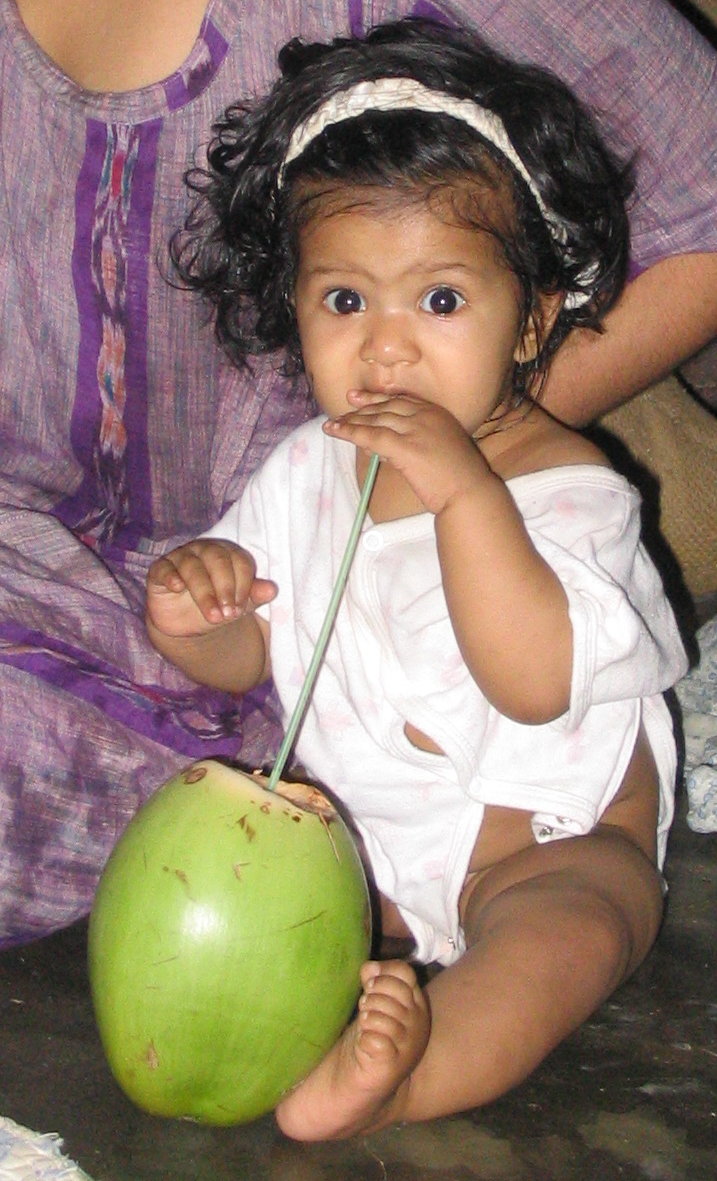
Khiyali tender coconut

The author’s daughter sipping nariyal-pani through a straw.

What all do you carry with you as snack or in between eats for toddlers when you travel?
– Mama of a 2.5 year old in Dallas

Try at Home: Enterprising Mama Sunita shares this recipe for a homemade Lara Bar.

In India: Refreshing tender coconut satisfies the munchies and quenches thirst. It is so great to find it at almost any bus stop, train station or marketplace.

Traditional travel snacks like khakra, tepla keep for a few days. Homemade cookies, muffins, or crackers are useful when a journey takes longer than expected. Don’t be put off by the subtitle, but I have gotten nice travel snacks from Bankeraika‘s www.bankeraika.com/

When they’re old enough, peanut butter is easy to carry around and one can get “whole wheat” bread nowadays in most food shops. I am not sure how whole it is, but it seems to be less empty than white. A bite of sandwich and bite of fruit like banana, chiku, orange, etc. makes jam unnecessary.

From hotels some options for the very young are: boiled potatoes, boiled carrots, raw tomatoes, idli, boiled chickpeas … sometimes we still order these when everything else on the menu is too spicy.

Things to stash in tiffin dabbas are: 1. puffed grains or rice cakes. 2. fresh fruit / veggies. 3. dry fruit like raisins, dates 4. nuts if they are old enough.

Insert nut in date after removing pit.  Use peanut, cashew, almond or any other nut.  Don't eat the clerodendrum!

Insert nut in date after removing pit. 

More:

Simple Raw Snacks

Simple Snacks 2

Energy Bars


Fruits vs. added sugar

In Why on 14 June 2011 at 3:20 pm

My dad says I am being silly being so strict about no added sugar while my daughter gobbles tons of whole fruit ! Any good argument other than the fact that fruits contain other nutrients and not just fructose too?:)

– mom of a 2.5 year old in Dallas

Obviously whole food is better than processed food. Because whole foods take time to chew, the body has time to feel full before one can overeat. Fruits contain fiber, and innumerable nutrients, not only the few that appear on the labels of packaged food. Michael Pollan writes in In Defense of Food that many nutrients that are available in the fresh, whole form are not absorbed from the processed versions (juice, jam etc). Nutrients are absorbed in synergy, chewing, etc. I have never heard of "overdoing" whole fruit but if you are concerned, I would look for foods from other food groups, rather than added sugar to balance the diet.

Most people, and most of our families a generation or two ago, eat food that was neither packaged nor processed, other than the processing done at home. Because this takes time, it is naturally limited. Now when processed sugar is far cheaper than whole foods, and packaged food is everywhere, how would we limit it?

There are a variety of approaches to food. Let me share my approach and why I believe it worked well in helping us have not only healthy eating habits but also healthy attitudes about food.

What I did was to avoid added sugar and refined grains entirely in the first few years of life. In the first year I avoided salt as well, This allowed my daughter to taste food on its own. Using these years to introduce a wide variety of foods, as close to their whole form as possible, set the foundation for a healthy and balanced diet. Introducing processed / sugary foods after she had years of experience with whole foods gave the whole foods an advantage – she didn’t like white bread or white rice – and allowed her to understand that different roles different foods played in our diet.

In the initial years we also avoided packaged food almost entirely – exceptions started with puffed rice / puffed millet and grew gradually. But mostly we cooked from scratch. Parents who followed this approach have told me that their child rejected "baby food" from the jar though when they made the same thing at home the child ate it quite happily.

By the time I was prepared to introduce refined / added-sugar foods, I was confident that my daughter and I could have a meaningful conversation about

– roles of a wide variety of foods
– limiting intake of refined foods e.g., after meals, not every day, not too much

– need to brush teeth (or in a pinch, eat a carrot / celery / apple) after sweet / sticky foods.

Above were guidelines we used in our family, yours could be different – the important thing is that you be ready to explain your guidelines, be answerable (why?) and also be flexible. [And feed them before birthday
parties ;-)]

In my experience, the "strictness" in the initial years makes restrictions obsolete in the later years. Incidentally I found the same approach effective with media as well.

Should I give baby vitamins?

In Yes / No on 10 April 2011 at 6:38 am

When I went to get my daughter’s check-up done, the doc said she’s not been putting enough weight and prescribed her vitamin supplement drops. I am not sure if this is necessary she’s 4months and weighs 5kgs (birthweight was 2.75kg).

– Rajitha, new mom in Mumbai

Going by the recommended weight gain of 100-200 grams per week, your daughter’s weight gain is within the expected range. If you think she needs more food, consider if you could feed her more often. Remember to switch breasts and try If she is already nursing whenever she wants, as long as she wants, then she is getting what she needs. Since your body will give priority to the baby, it is possible that you need to make sure you are getting all your nutrients. In general it is recommended that mothers continue to take prenatal vitamins & minerals for at least 2 years while breastfeeding, though of course it is (more) important to eat a balanced diet of whole grains, fresh seasonal foods.

More info:
Kelly Mom: Does my baby need vitamins?

Dr Sears: Newborn weight gain