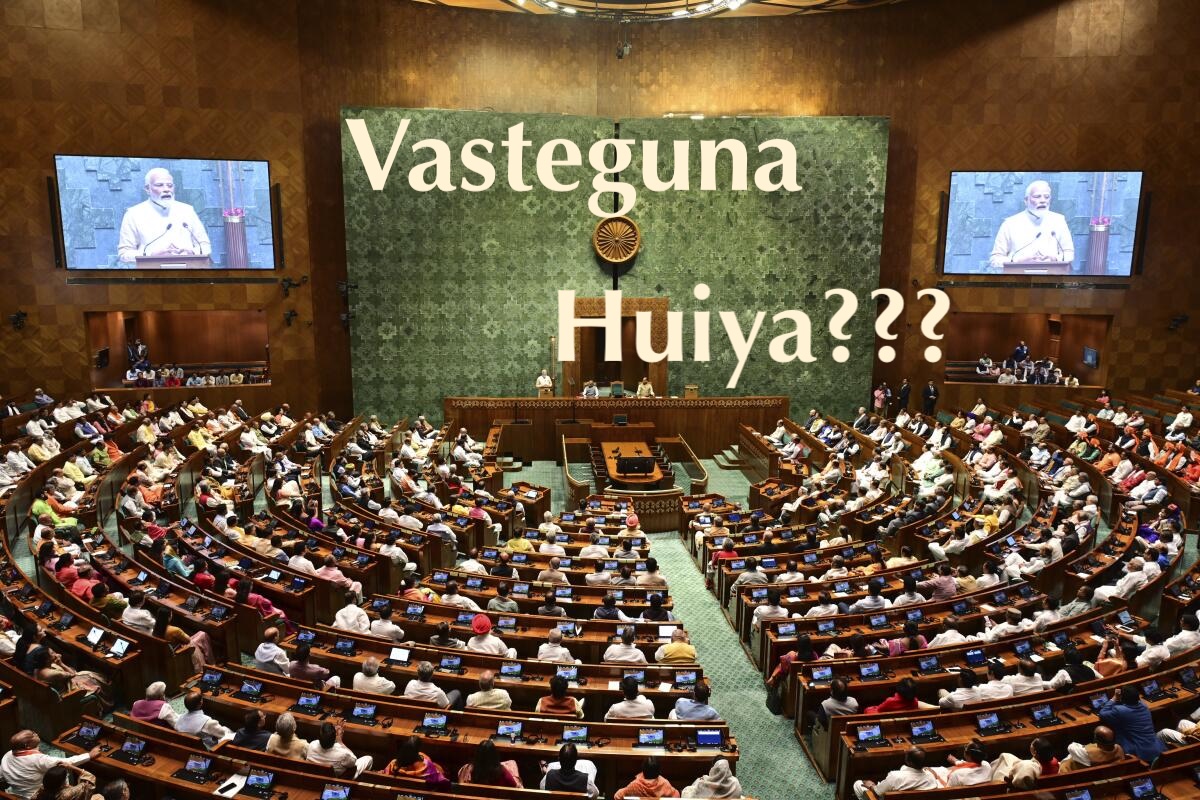
Were I in India I’d be at Jantar Mantar, were I a youth I’d have been there all month and were I still a practicing librarian I’d love to make a video like the LA Public library did about 6/7 but about “Vaste Guna Huiya” which appears on protests signs and in short videos students have posted, notably during police interactions. In those videos, it seems a way to ask the police “what are you even doing here?” but using a meaningless phrase to convey the nonsensical nature of police / state intimidating and attacking youth.
Question Authority has always been a motto of Amma, even or especially when she is the one exercising the authority. When you respect someone in a position of authority but disagree with a decision or policy, you will present your objections and raise specific questions. When the authority figure respects you, they will consider your points, and engage in a discussion in which you and they try to understand each other and come to path forward that does not depend on the power of the person in authority. Translating to parent-child terms, it will not be “because I said so” but for reasons for which one can be held accountable by one’s child.
People often say, “respect authority.” According to Amma, there is no conflict between “respect authority” and “question authority.” Quite the opposite. It is in fact a mark of respect to believe that the person in charge actually has reasons behind their policies, and is sensible and caring enough to hear from and be answerable to those they expect to abide by those policies. And mature and humble enough to change them based on their input.
When someone abuses one’s authority or worse, claims authority on the basis of might makes right, ability to deploy violence, patriarchy, wealth, age, divine dispensation or other unaccountable basis, then the above becomes irrelevant or impossible.
Authoritarians do not invite questioning. They use their authority to silence questions. For someone in authority to say “don’t ask questions” actually indicates a lack of self-respect.
And that is why the question to ask someone who does not respect their own authority enough to be answerable, is Vasteguna Huiya?!
Every Joke is a Revolution
Explaining how she came to bring this phrase into the zeitgeist, Sakhi, a student of Delhi University and member of the Students Federation of India, told Vipul Kumar of the The Wire that she saw a video in which a kid uses this very phrase to sneak up on an uncle, who then runs away. Invoking the code of the student protests that “every joke is a revolution” she recalled the uncle-spooking meme and made the video of herself calling to the police “Vasteguna huiya!”
She says it came as a surprise to her that that this particular video made the rounds because she had actually been attending the protest from day one. “Every day I was putting out videos trying to get our message out,” she explained.
Internet Etymologists Say …
Shivani Dixit of India TV News, traces the now-famous phrase back to an old video of a kid jumping from the top of the staircase, in response to a friend or perhaps sibling asking “Can I get a “Hoyi Yeah?” which is perhaps a thickly accented or willfully modified “Oh Yeah.” Landing on a mattress placed at the bottom of the stairs, the kid gleefully gets up and says, “Oh Yeah!” to which the first kid rejoins, “Hoyi Yeah!”
As Ameesha S of Free Press Journal notes, there is no evidence that the two are linked. Even if they are, it has become the “6/7” of the students’ protest. One Deepender Singh Hooda quoted it in parliament today. In 2005, at the age of 27, he became the youngest member of parliament in India. In his speech today he praised the youth who protested with the constitution in hand, with revolutionary slogans, and using terms of endearment like “kuchu puchu” when calling for the education minister to resign. He also called out the government for its unwillingness to hear the students or allow them to speak. “The government sought to suppress the voice of the youth,” he noted.
I know I am jumping on the bandwagon of internet lore but if there are other origins of this phrase I hope we hear about them too. Meanwhile, here is that 2015 video – and I can’t help thinking, “No more monkeys jumping on the bed? Think again.” The monkeys are not listening! Instead they are cheering each other on, catching each other when they fall, and getting right back up again.
Read / Watch More:
CNN-News18 Deepender Singh Hooda addresses parliament about government response to student protests: https://youtu.be/zLiIiZUyvGc
Sakhi Delhi University: https://www.instagram.com/sakhi.bandhu/
India TV News: what-does-vasteguna-huiya-mean
BBC: Delulu, Clock it: Cockroach protest brings Gen Z slang to India’s parliament
Free Press Journal: what-is-vasteguna-huiya-the-viral-gen-z-phrase-that-has-made-its-way-to-parliament
Reddit: my_mom_is_asking_me_what_does_vastegana_huiya
LA Public Librarian explains 6/7: https://www.instagram.com/reels/DQczNe7EmBr/


 Ask Amma