We are all about breakfast! Lunch often has to be pack-able and dinner comes with its own expectations, but breakfast allows for great variety, not to mention decoration.
Next question … what’s for breakfast? Below is a visual menu of simple, delicious breakfast options – click on a picture for details. Guess what, they are all vegan as well.
Blend tofu, basil, mint, roasted red chilli, almonds (pine nuts or any other nuts), olive oil , salt. Spread over toasted bread and slice tomatoes (or cherry tomatoes). Coutesy Chetana, Bangalore.
Steel cut oats, soaked and cooked. Topped with almond and date and surrounded with sliced apple.
Under those sliced bananas is a slice of toast with peanut butter. We’ve surrounded this with sliced peaches. Peanut-butter-peach-banana. Who needs J when you can have PB&PB?
Slice ripe mangos and place on toasted bread.
Savoury Oatmeal with vegetables
Bread quarters with hummous and sliced tomato
Idli made of rice and urad
Mix 1 part sprouted ragi flour and 2 parts water, bring to a boil while stirring continuously. Video
We started with 18 cups of oats and now have 27 cups of granola!
After the runaway popularity of simple snacks, here is a second set of simple snacks. The first set of snacks used raw ingredients.
The snacks pictured below involve some cooking or include ingredients that aren’t raw, such as puffed rice (in the bhel) or bread (in the mango toast). You can adjust the proportions to your taste. For those who want more guidance, I have posted recipes for some of these such as Ragi and Hummous.
Slice ripe mangos and place on toasted bread.
Mix up grated carrots, chopped onions, corriander, roasted peanuts, lot of lime juice with puffed rice. Chetana K, Bangalore.
Mix 1 part sprouted ragi flour and 2 parts water, bring to a boil while stirring continuously. Video
Boil kabuli chana (garbanzo beans). Sprinkle salt to taste and serve. Good with a dash of lemon juice too!
Blend boiled chickpeas, garlic, salt, lemon juice and olive oil.
Watch this page, as we add photos of simple snacks that can be made in a jiffy.
These snacks may require cutting or blending but generally not cooking and are easy to prepare just-in-time, often with kids’ participation, lending a special sparkle to snacktime. They are made of whole foods, usually raw.
Blend ripe bananas, walnuts, peanut butter and cocoa. Top with pomegranate. Chetana K, Bangalore.
Chop carrots and cucumbers. Sprinkle lemon juice to taste. Don’t eat the dahlia.
Blend cocoa, dates, nuts and oats. Form into balls and chill. 1 part each nuts, oats and cocoa to 4 parts (pitted) dates. Image from http://organicmamas.blogspot.com
Grate carrots. Sprinkle lemon juice to taste.
Insert nut in date after removing pit. Use peanut, cashew, almond or any other nut. Don’t eat the clerodendrum!
Blend mango, banana, cornmeal (leftover from breakfast) and a dash of whole raw milk. Sonika S, Arlington.
Cut peaches and plums into sectors. Irresistible!
Slice banana lengthwise. Top with peanut butter.
Slice banana and cut apple into thin sections. Arrange in a happy face! Chetana K, Bangalore.
Smoothie! Spinach, beetroot, carrots, and tomatoes.
Musk Melon and Pomegranate. Edible Art. Disha, Bangalore.
Slice banana lengthwise. Top with peanut butter and a dash of grated coconut.
I have been referring to granola so often that I realized I ought to post a recipe. I have been making this granola since I was eight years old. Here is the original recipe that I had taped to the wall in our kitchen in Beech Grove.
Ingredients:
3 cups rolled oats
various nuts and seeds, 1/4 cup each
3/4 cup wheat germ
1/4 cup honey or molasses or maple syrup
1/4 cup oil
1/4 tsp vanilla
1/2 cup raisins, chopped dates or other dried fruit.
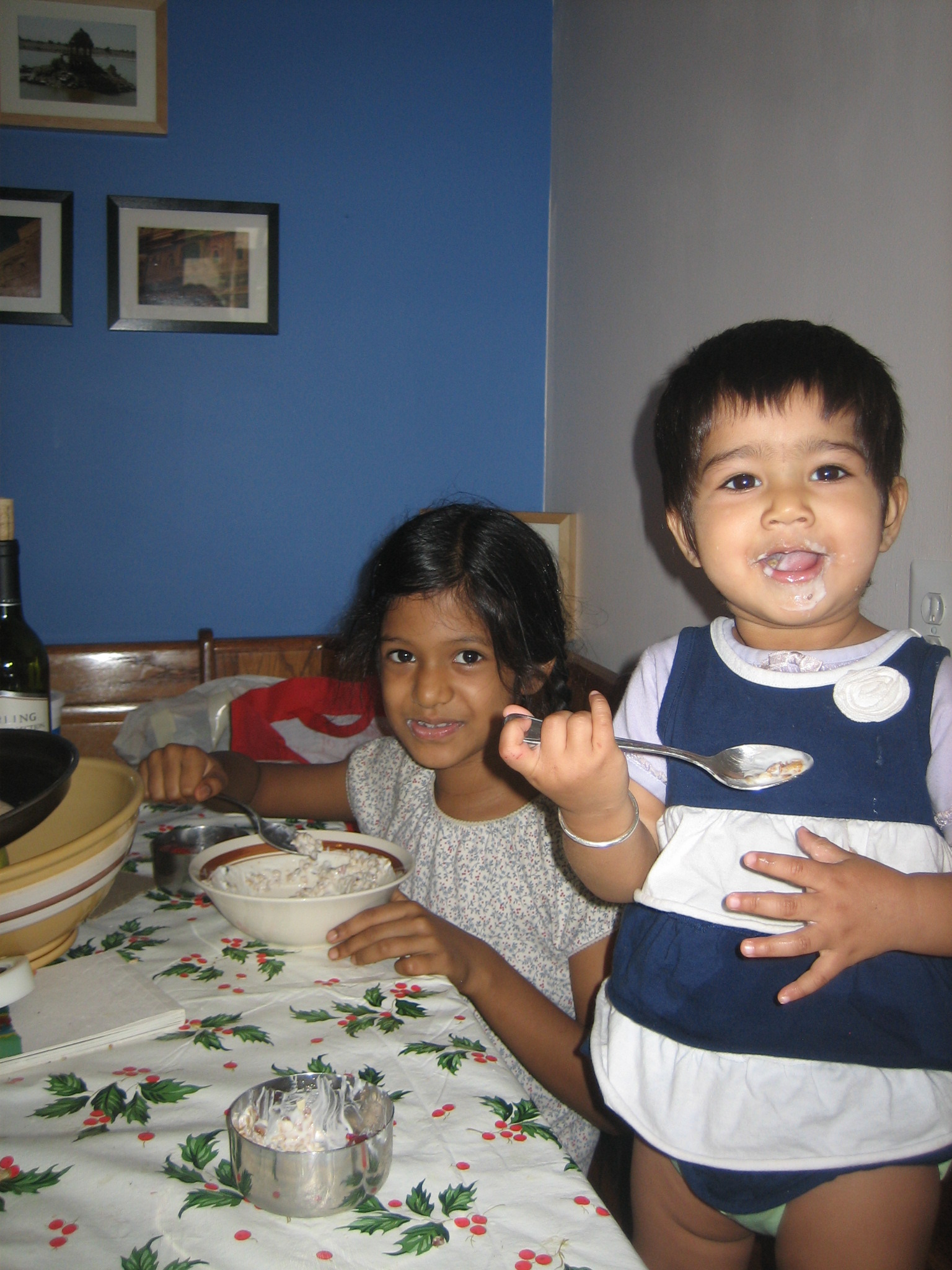
Yummy in my tummy! Granola with yogurt.
Instructions:
Mix oats, nuts, seeds and wheat germ.
In a pot, heat oil, honey and vanilla and stir well. Pour over the mixed dry ingredients and mix throughly. Spread onto large baking pans.
Bake at 300 degrees for 20-30 minutes stirring every 10 minutes to prevent burning. When done granola will be golden brown and make a crisp sound when you stir it.
Allow to cool and mix in the raisins, dates or other dried fruit. Store in an airtight jar or sealed container.
Eat with chopped fresh fruit and/or yougurt or milk. Can also eat with applesauce or all by itself.
* * *
Notes: Generally I used almonds, peanuts and sunflower seeds. If we had cashews or walnuts I threw those in too. Sometimes even sesame seeds.
I usually tripled the recipe, sometimes more. So I started with 9-18 cups of oats. It keeps well for a few weeks.
Over the years, I have modified the recipe.
My mom told me that I could make it chunky by adding some whole wheat flour and water at the end and just scooping up fistfuls and chunkifying them.
If you make and eat it the same day you can skip the oil and not miss it.
Throughout my childhood I loved the step of heating the oil and honey, mostly because I loved to watch it bubble. Later I realized however that this step could easily be skipped.
The vanilla is optional, as is almost everything – except the oats!
In fact, I recently jotted down the recipe to send someone, and this is how it goes:
12 cups rolled oats.
3 cups wheat germ
1-2 cups sunflower and/or pumpkin seeds
1-2 cups of chopped almonds, cashews, walnuts, and/or pecans
1-2 cups raisins and/or chopped dates. If your store sells date pieces like these, then you don’t have to chop!
1/2 cup oil
1/2 cup honey or molasses or maple syrup
optional: 1/2 tsp vanilla
optional: wheat bran or oat bran
For chunky texture, you will need a cup or so of flour and some water to work in after mixing up all the rest of the ingredients.
In keeping with the crunchy nature of granola making, the photos below come from my most recent batch, which I started with 18 cups of oats.
Add sunflower seeds
Chop 2 cups of almonds and add.
Add 2 cups cashew pieces
Add 18 ounces honey.
Add 1 cup safflower oil
Bake at 350 degrees fahrenheit, stirring every 10 minutes till done.
Remove from oven when golden brown, let cool before packing
We started with 18 cups of oats and now have 27 cups of granola!
Sustainable agriculture, food security and good health depend a diverse diet including coarse grains such as millets of many varieties. Finger millet, also known as ragi or nachni is making a come-back in the urban areas. Similarly other varieties such as foxtail millet and little millet, well known to our grandparents also deserve a place on our plate.
Peter writes from Appalagraharam with some recipes using delicious varieties of millet. One is fried, the other is steamed. Enjoy!
Been experimenting with millets whilst Swandana and Nirma are in Orissa visiting the clan…
Yummy Fried Foxtail Millet (కొర్ర). Photo by Peter Bakos.
Really yummy fried foxtail millet (కొర్ర )
The rice is dry fried till it almost reaches popping stage then a tablespoon or so of oil and teaspoon of salt per cup of rice is added and stirred. Then cold water, two and a half cups the quantity of rice is added and allowed to boil in a lidded vessel.
If you have an Ez-cooker you can just bring to the boil then allow to cook in the Ez-cooker for about half an hour … If cooked in a pressure cooker, two whistles is enough.
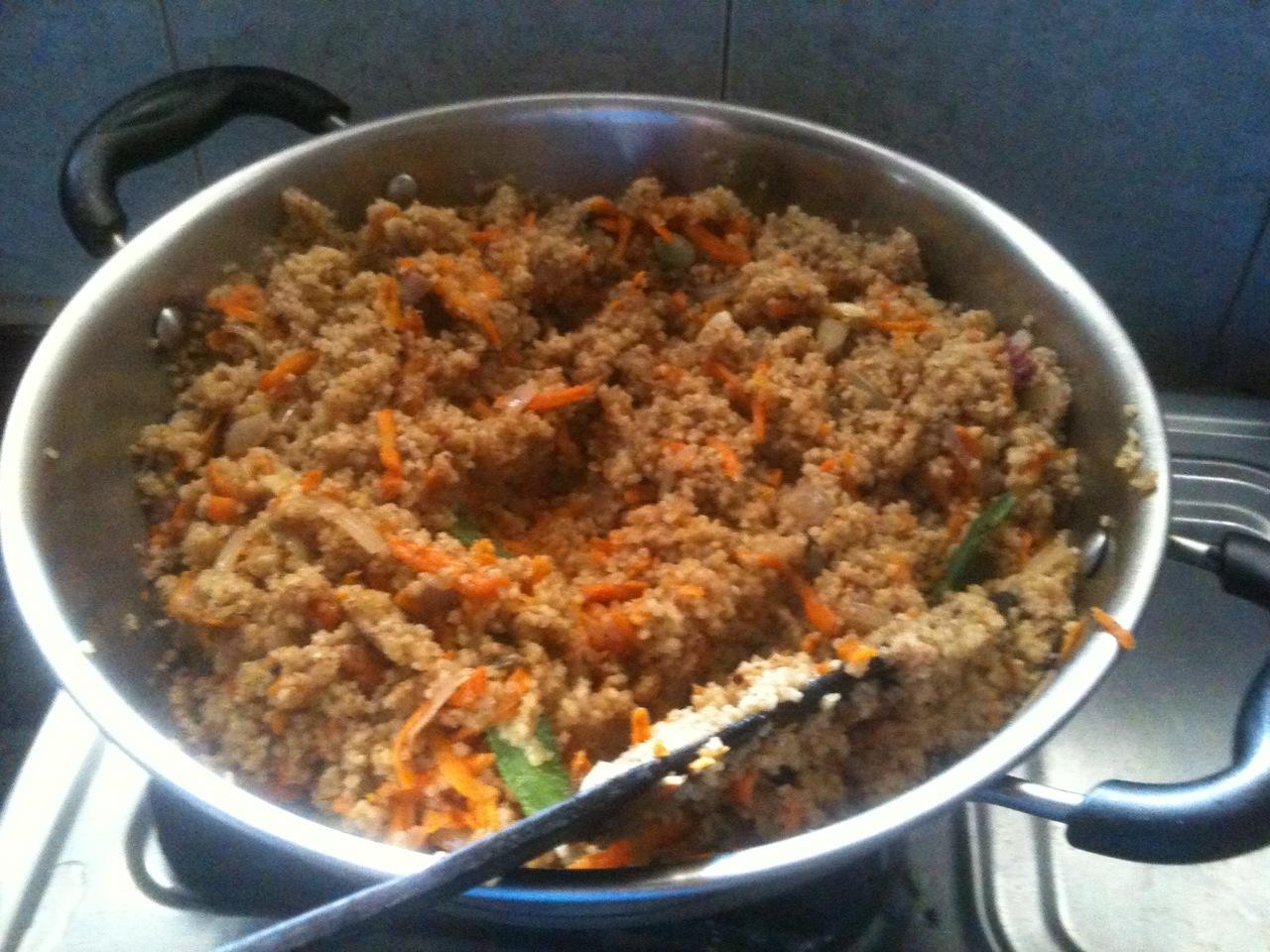
In a wok, garden-fresh spinach, beans, onions, garlic chives were sautéed with a shop-brought carrot, grated. The then millet rice was added and stirred in.
Eaten with a side- dish of home-made lemon pickle.
The rice came out really light & fluffy with a nutty flavor.
Little Millet (సామ బీయము)
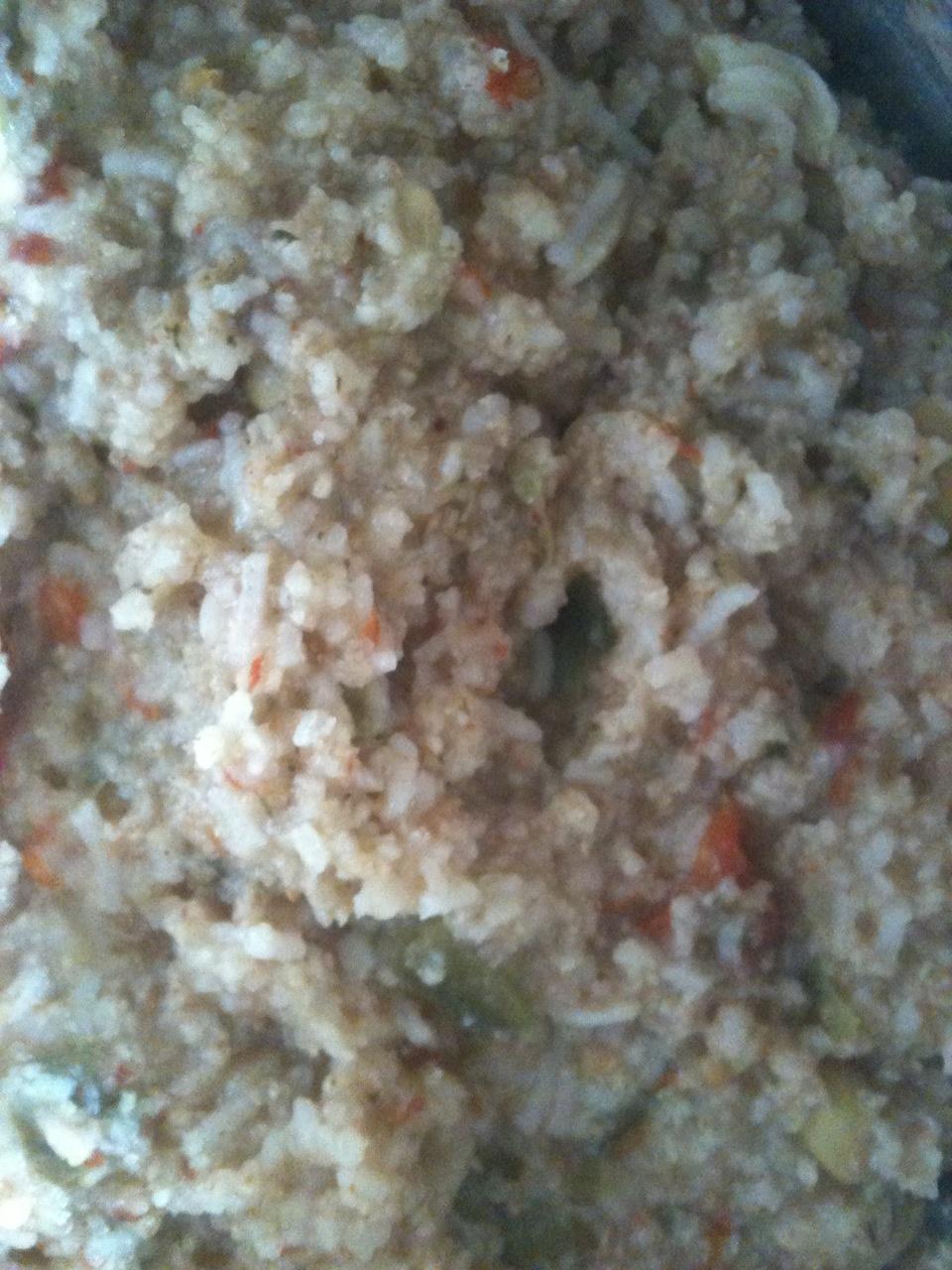
Little Millet (సామ బీయము) with assorted vegetables. Photo by Peter Bakos.
This was an “as you’re walking out the door” kind of meal. Spent more time harvesting the veggies from the garden than we did cooking. Since the EZ Cooker vessel was in use, I used the pressure cooker for this one.
Assortment of spinach, radish leaves, onion & garlic chives, beans & tomato were coarsely chopped and lightly fried in the pressure cooker with fresh herbs and a little salt.
Then I added little millet and water – 2.5 times as much water as millet. Stirred and covered. Three whistles later it was ready. A quick bite , steaming hot then packed in the tiffen box with a couple of millet rotis… The perfect lunch for a village visit.
I haven’t used ragi ever …and till now I thought it was something like other grains – just buy it and cook it. All this sprouting thing is confusing me. Can anyone please explain how its done? Or how can I introduce ragi to my daughter? Do I need to sprout it?
– Krishna, mama of a 14 month old in Delhi
You can cook whole ragi directly, in upma and other preparations, but as a baby food, it is typically ground into flour and made into porridge.
You can eat it without sprouting, but sprouting improves its nutritional value. Some (like me) also prefer the taste of sprouted ragi flour.
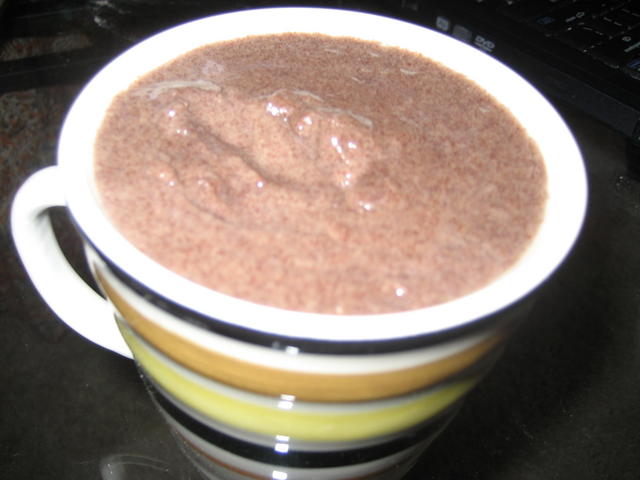
Yummy! Ragi in a Cup
In rural households, sprouting ragi at home is part of the routine work in the kitchen, just like cutting vegetables or making yougurt – even though one can buy ready-made yougurt or pre-cut vegetables in the urban supermarkets. You will retain more nutrients and flavour if you buy your ragi whole and process it at home. When my sister bought a flour grinder, I could easily taste the difference between bread baked with flour ground on the same day as compared to week-old flour. Renewed interest in slow food has inspired urbanites to learn from their rural cousins. Here is a beautiful site explaining how to sprout the ragi at home.
You can also buy sprouted ragi flour. Our first packet came from a company called Dharani (Bangalore) and later we got it from Ecofarms, based in Yavatmal, or Conscious Foods (Mumbai) and now from Satvika, just a hop skip and a jump from us in Chembur. In short, sprouted ragi flour is sprouting up everywhere 🙂 As more urban folks are becoming aware of its nutritional value and also forgetting the art of sprouting at home, the price of sprouted ragi flour has steadily risen and currently in Naturally Yours, our local organic shop in Chembur, the price is Rs. 70 for 500 grams. Whole ragi comes for Rs. 49 per kilogram.
Since ragi absorbs some water during the sprouting process, you will need to add less water when cooking sprouted ragi flour than when cooking unsprouted ragi flour.An internet search quickly yields several recipes for ragi porridge but all of them involve additional ingredients that we do not want to include in baby’s first food.
This ragi porridge is so simple it hardly merits a recipe, but then some people won’t believe it can be done so simply unless they see it described in loving detail on an internet site, so here we go.
Khiyali demonstrates how to make ragi porridge.
Ingredients
1/4 cup ragi flour or 1/3 cup sprouted ragi flour.
1 cup water
Instructions:
In a pot, mix the ragi flour with cold (room-temperature) water. Stir vigorously with a fork till it is nicely dissolved and there are no lumps.
Slowly bring to a boil over medium flame, stirring continuously. As it comes to a boil, it thickens. Once the ragi is thick, remove from flame and let sit for 10 minutes.
Ragi Porridge in a cup
If you prefer a thicker porridge, you may increase the ragi by a spoon or two – just play around till you have the consistency you like. To get a thick porridge using sprouted ragi flour, I usually use 1 cup flour with 2 cups water, as demonstrated in Ragi Porridge: the video.
You can double the water if you want to have it as a drink.
For babies, this is ALL you want to use. No salt, sugar, milk, or nuts. Eaten fresh and warm, this is a satisfying porridge all by itself.
Why do we not add anything else?
Here are some reasons for avoiding the following common ingredients, when preparing food for babies and young children.
Milk – Babies absorb iron from breastmilk very well, especially when no other sources of iron are in the stomach at the same time. So don’t mix baby’s ragi with breastmilk – that will lower the absorption of iron. Don’t mix it with cow’s milk either. Ragi (especially sprouted ragi) is high in calcium and iron, and cow’s milk makes it more difficult to absorb iron from foods (See Iron Deficiency). For human babies, (other) animal milk is nutritionally inferior to mother’s milk and also inferior to ragi. Why fill baby’s stomach with an inferior food?
Nuts – In light of the rise of allergies particularly in Western countries and other parts of the world adopting Western lifestyles, a number of health specialists recommend delaying nuts till age 2, and in particular delaying peanuts till age 3. One must be even more cautious if there is a family history of allergy. Even nursing mothers are advised to avoid nuts until the child is old enough to have nuts. If you aren’t living in a western lifestyle, and have no family history of allergies you may take this caution with a grain of salt, as it were.
Added salt – Give your baby a chance to taste food as it is, without added salt. Salt has its place and there is nothing wrong with eating it but one should not depend on salt to make food tasty. One should be able to enjoy the taste of plain vegetables or grains. Delaying salt till at least 12 months allows the palate to grow accordingly.
Added sugar – same logic as above. Let babies and children taste the flavours already there in foods, without depending on added sugar to render things sweet. By delaying added sugar till age 4 or 5 years, one can get used to a variety of flavours, build healthy eating habits, and also diversify one’s repertoire for desserts and treats that use the sweetness already there in fruits and other whole foods.
Many babies eat plain ragi porridge quite happily. Once your child is chewing you can try adding fresh or dry fruits if you think s/he would like that. I usually saved the fruits to have as a snack at some other time of day. After my daughter started having nuts, I would add raisins or dates and crushed almonds to the ragi porridge and she liked that too. In fact she still does 🙂
Video: EZ Cooker is good for ragi too. Of course even on the stove it cooks quickly, but you can shave a minute or two off the stovetop time by transferring to the EZ cooker once it starts to boil. Once it is in the EZ cooker it cannot burn or boil over. It will not thicken as much as it would on the stove but if you like a softer porridge this is just right.
So many people ask about cough and cold, so here we go.
As a student I used to observe that I would typically come under the weather right after exams were over. It was as if my body was saying, “now it is my turn.” So be fair and give yourself some TLC (Tender Love and Care NOT Tomato Lettuce and Cheese but you can have some of that too. Minus the Cheese. Signed, Humor Consultant*) rather than insisting on business as usual. My three point plan for recovery was:
1. aggressive sleeping: sleep until you can’t sleep any more
2. More gentle readers may wish to call the second point “continuous water sipping.” For those young enough to breastfeed, they can nurse and sleep at the same time. I nursed my daughter through several fevers this way. Read the rest of this entry »
What should I use to bathe my newborn baby? Her skin seems to be peeling off 😦
– mom of a newborn who is not exactly like her first-born
Newborn skin peeling, while apparently normal, seems to be one of those things that you know will stop, yet, you worry till it does.
Regarding bathing, what I use and recommend for young and old alike is besan, or chickpea flour. Sunnipindi – mung dal (green gram) flour mixed with rice flour – feels even better but requires mixing two ingredients rather than just one. Be it besan or sunnipindi, I simply add water to make a paste, rub on the skin and rinse off. If you leave it to dry for a minute, you have to rub while rinsing, getting the exfoliating effect. Voila – clean, smooth, baby-soft skin. Some people get fancy and mix in yogurt, oats, honey, or dry flowers, neem leaves, orange peels, turmeric etc. So if your little one gets his oatmeal all over his face, he just may be onto the secret of a glowing complexion!
Make sure your oranges aren’t sprayed or your turmeric artificially coloured. An even simpler approach is to use plain water, especially if bath is primarily a time for play and relaxation.
As any toddler will tell you, fermented food, when made at home, gives rise to fundamental questions, like who made the first yogurt? It also brings us in touch with our neighbours, like when we need to borrow a spoon of yogurt because somehow we forgot to make our next bowl of yougurt before finishing our last one. It also takes us down to the microbial level, and keep our forces of friendly bacteria strong.Can anyone offer a plan for peace? It seems that among its many other roles, Sandor Katz’ “The Art of Fermentation” may be that as well as inspiration to make new discoveries in the kitchen and on our taste buds, and reconnect with the “hand taste” that goes into food made with love. And, because fermented food begs to be shared, it may carry us away from the grid of the cash economy.
Michael Pollan says that “Katz would have us renegotiate the terms of our relationship with the microcosmos, and The Art of Fermentation is an eloquent and practical manifesto showing us exactly how to do that…”
An idea whose time has come! I am typing with this book in my lap, struggling between the urge to share the good news about this book with you and the urge to read more and actually try out some of these fermentations myself, just to see what happens!
Title: The art of fermentation : an in-depth exploration of essential concepts and processes from around the world
Author: Katz, Sandor Ellix, 1962-
Publisher, Date: White River Junction, Vt. : Chelsea Green Pub., c2012.
Quinoa Upma
This Recipe comes to us from Meenal Amma in Rockville
Ingredients:
1 cup quinoa
1 1/2 cups water
1 medium onion, chopped
1-2 green chilies, finely chopped
dash of jira (cumin seed)
handful of peanuts
salt to taste
juice of 1 lemon
handful of kothimira (cilantro), chopped
Steps:
Bring Quinoa to a boil and simmer for 15 minutes – it should split up during the boil so you know its done. You can also cook this in a pressure cooker or the EZ Cooker.
In minimal oil, saute onions, jira and peanuts till peanuts are brown but not burnt.
Add green chillies. Saute lightly if desired.
Add boiled quinoa and salt. Mix it up, squeeze in some lemon juice and top with kothmira.
Send your questions on health, hygiene, learning, discipline, sleep, sanity, serendipity, chaos and any other aspect of parenting, real or imaginary to askammanow@gmail.com










 Ask Amma