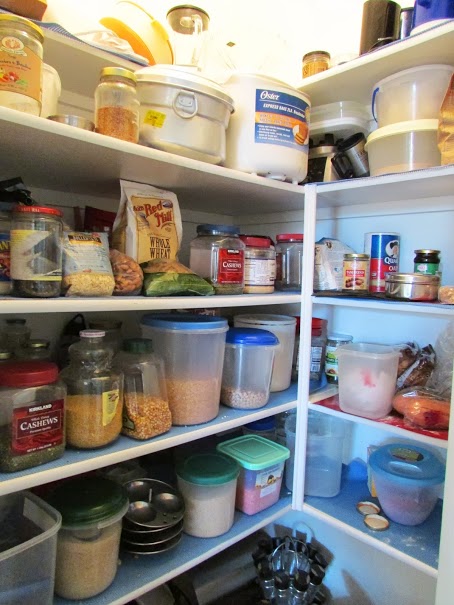
Kitchen shelves … ready for cooking.
This is an ordinary set of kitchen shelves. But today it brought back memories.
Long long ago in a land far far away I moved into a house of 13 people. Read the rest of this entry »
Kitchen shelves … ready for cooking.
This is an ordinary set of kitchen shelves. But today it brought back memories.
Long long ago in a land far far away I moved into a house of 13 people. Read the rest of this entry »
How often do we hear that children won’t eat? No one loves this message more than the food industry, which is ready to jump in with factory-tested flavours and bliss points, adding salt, fat and sugar, flavor, color and stabilizer in indsutrially calibrated quantities to design foods that hold mass appeal. “Kids today don’t eat food!” declares an advertisement for a popular packaged meal. On the screen we see a child pushing away a plate of vegetables, dal and roti and brightening up considerably when the packaged bliss comes forth in steaming digitally enhanced ringlets.
How often have we seen parents or grandparents run behind a child with a bowl of food or hire someone to perform this task? Read the rest of this entry »
I have been referring to granola so often that I realized I ought to post a recipe. I have been making this granola since I was eight years old. Here is the original recipe that I had taped to the wall in our kitchen in Beech Grove.
Ingredients:
3 cups rolled oats
various nuts and seeds, 1/4 cup each
3/4 cup wheat germ
1/4 cup honey or molasses or maple syrup
1/4 cup oil
1/4 tsp vanilla
1/2 cup raisins, chopped dates or other dried fruit.
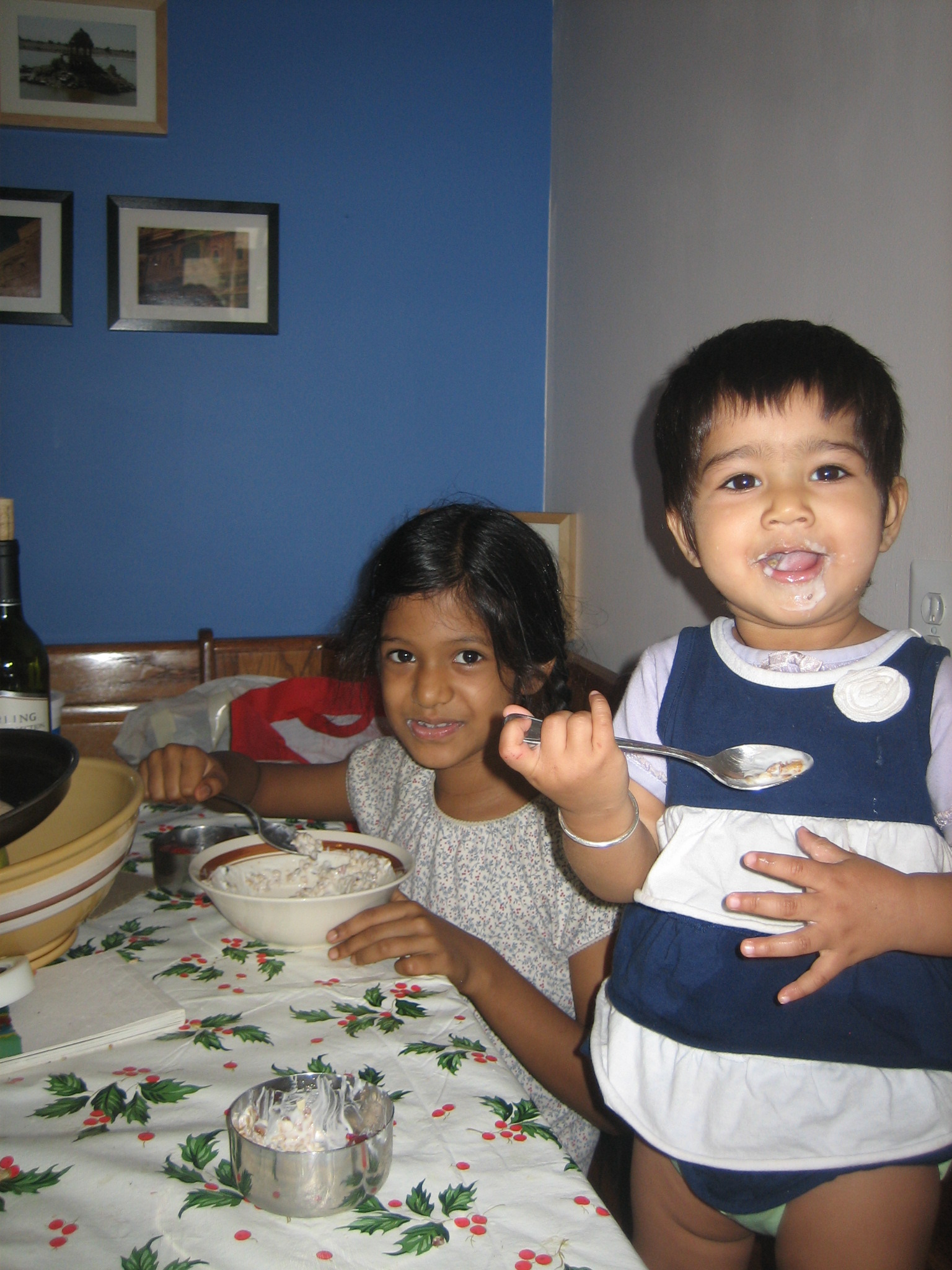
Yummy in my tummy! Granola with yogurt.
Instructions:
Mix oats, nuts, seeds and wheat germ.
In a pot, heat oil, honey and vanilla and stir well. Pour over the mixed dry ingredients and mix throughly. Spread onto large baking pans.
Bake at 300 degrees for 20-30 minutes stirring every 10 minutes to prevent burning. When done granola will be golden brown and make a crisp sound when you stir it.
Allow to cool and mix in the raisins, dates or other dried fruit. Store in an airtight jar or sealed container.
Eat with chopped fresh fruit and/or yougurt or milk. Can also eat with applesauce or all by itself.
* * *
Notes: Generally I used almonds, peanuts and sunflower seeds. If we had cashews or walnuts I threw those in too. Sometimes even sesame seeds.
I usually tripled the recipe, sometimes more. So I started with 9-18 cups of oats. It keeps well for a few weeks.
Over the years, I have modified the recipe.
In fact, I recently jotted down the recipe to send someone, and this is how it goes:


Today’s India Together article “The Obesity Epidemic: Are Parents to Blame?” raises the question of how parents can encourage good eating habits.
While the article raises useful points, it unfortunately retains a top-down approach of parents dictating to children or experts dictating to parents. This will not work. What will work is for parents to trust their children from birth. They neither need to tell their children to eat nor tell them not to eat.
The article touches on the importance of breastfeeding, starting with exclusive breastfeeding for the first 6 months, but does not recognize the full scope of breastfeeding to help nurture good eating habits. Read the rest of this entry »

(Jakarta, June 7, 2013) Cheers of “Hooray for peasant women! We are the mothers of food sovereignty!” launched the IV Women’s Assembly of La Vía Campesina
IV International Women’s Assembly for the construction of a peasant-based and popular feminism.

Which sugar substitute is best? Dates, molasses or honey? I quit using agave.
– mother of two in Dallas
(a) is a whole food so I will go with (a).
I use any of these three, depending on the context. If you can get raw honey it is supposed to have beneficial properties that are destroyed in the high-temperature processing of the commonly available honey.
Sonika Amma adds:
I would prefer dates and molasses on the health quotient. Read the rest of this entry »
Ragi Porridge (not just for babies!)
I haven’t used ragi ever …and till now I thought it was something like other grains – just buy it and cook it. All this sprouting thing is confusing me. Can anyone please explain how its done? Or how can I introduce ragi to my daughter? Do I need to sprout it?
– Krishna, mama of a 14 month old in Delhi
You can cook whole ragi directly, in upma and other preparations, but as a baby food, it is typically ground into flour and made into porridge.
You can eat it without sprouting, but sprouting improves its nutritional value. Some (like me) also prefer the taste of sprouted ragi flour.
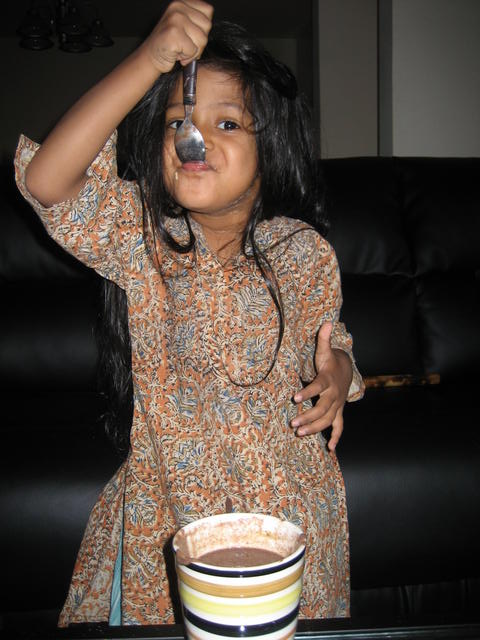
Yummy! Ragi in a Cup
In rural households, sprouting ragi at home is part of the routine work in the kitchen, just like cutting vegetables or making yougurt – even though one can buy ready-made yougurt or pre-cut vegetables in the urban supermarkets. You will retain more nutrients and flavour if you buy your ragi whole and process it at home. When my sister bought a flour grinder, I could easily taste the difference between bread baked with flour ground on the same day as compared to week-old flour. Renewed interest in slow food has inspired urbanites to learn from their rural cousins. Here is a beautiful site explaining how to sprout the ragi at home.
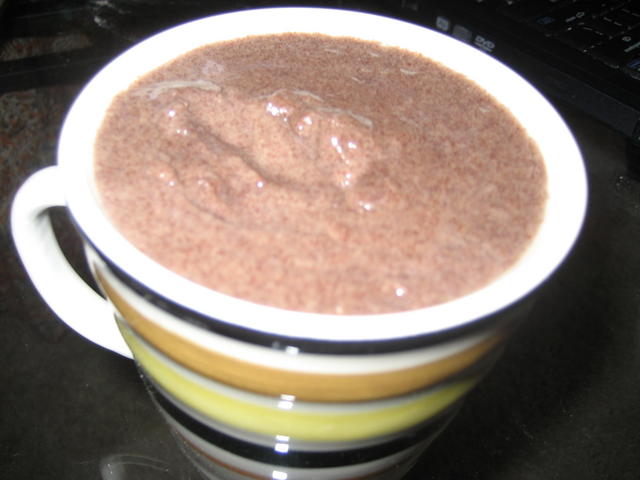
Ragi Porridge in a cup
If you prefer a thicker porridge, you may increase the ragi by a spoon or two – just play around till you have the consistency you like. To get a thick porridge using sprouted ragi flour, I usually use 1 cup flour with 2 cups water, as demonstrated in Ragi Porridge: the video.
Though I believe in giving choices I am concerned about how we offer choices with information and help children understand consequences that follow. So I come back to the basics to understand what choices actually are.
Is a choice:
– to offer a child two snacks and letting him pick on his own? (The snacks are decided by us.)
– or to let the child choose something from whole pantry itself.
– or, when a child wants sugar or desserts (too much of which we don’t want in their food) to offer apple, grapes etc instead of sugar or desserts.
– Amma of a 3 year-old in California
Before coming to the specific question on choice of snacks, let us look at the general question of offering choices. Read the rest of this entry »
First, let’s talk about weight gain. Read the rest of this entry »
Dear friends, we have talked about food security, food traditions and the rise of industrial food, packaged food, food-substitutes. Often these are based on false advertising, unverified health claims, pseudo-science or violation of advertising standards. This is true not only in India but around the world – but in countries where regulations are regularly updated and enforced, these ads are challenged and in some cases banned.
Readers, now is the time to collect every specimen you can find of advertisements and promotions for “baby food.” This includes
What you need to do: Find these ads in any language and submit them to Nupur Bidla at nupur@bpni.org
who will present on this issue at the World Breastfeeding Conference taking place in Delhi this December. Deadline is Sept 20.
While we will try to collect as many as we can from India, but please note that this is a GLOBAL conference – the ads may be from ANY COUNTRY.
You may use the attached Submission Form to indicate where the ad appeared and what inappropriate content was included.
Just in case you are curious:
Marketing of infant milk substitutes is governed by the IMS Act 2003
Infant Milk Substitutes, Feeding Bottles and Infant Foods. Its points are summarised by the infant milk industry here.
Advertisements for the edible-food-like substitute, Horlicks, was banned from airing in the UK because of its unverified claims to increase children’s height, strength and brain power.
Ban for Horlicks and noodle ads
TV ads banned for being ‘too strong’
The Advertising Standards Authority (ASA) of UK commented:
“The health and nutritional claims made by GSK and Nestle may be allowed in other parts of the world, but they breach the strict rules in the UK and we have seen no evidence to substantiate them,” he said.
Yet these ads continue to air unchallenged in India today.
I hope that this effort to document the appearance of these ads will encourage more fact-checking and will compel the government to enforce standards for advertising in India.
Deadline is 20 Sept 2012. Please use the attached form to send in the copies of ads that you find. A sample ad with the inappropriate claims highlighted is included in the form.
Many of you have asked me how we can fight false advertising of the packaged food and food-substitute industry. Please let us make use of this invitation from the World Breastfeeding Conference.
enclosed: Letter from Breastfeeding Promotion Network of India Member (cover letter to submission form)
Dear Friends,
Greetings from BPNI!
There is good news for you!!
Deadline for Submitting your entry for the “ATLAS of Baby Food Promotion” has been extended.
Now you can submit /report your contribution by 20th of September 2012.
To send your entry please click here to see the guidelines.
We wish you could be a part of this historical Atlas, we would be happy to hear from you through a confirmation mail.
Warm Regards,
Dr. Arun Gupta MD FIAP
Regional Coordinator IBFAN Asia,
Member, Prime Minister’s Council on India’s Nutrition Challenges,
Phone 91-9899676306
 | Ask Amma on Swanky Little Millet Idli… |
 | Anitha S on Swanky Little Millet Idli… |
| Ask Amma on Amaranth Dosa and Waffle |
 | Aswathy Palakkal on Amaranth Dosa and Waffle |
 | Venkateshwarlu on What can we make with Millet i… |
Send your questions on health, hygiene, learning, discipline, sleep, sanity, serendipity, chaos and any other aspect of parenting, real or imaginary to askammanow@gmail.com

 Ask Amma